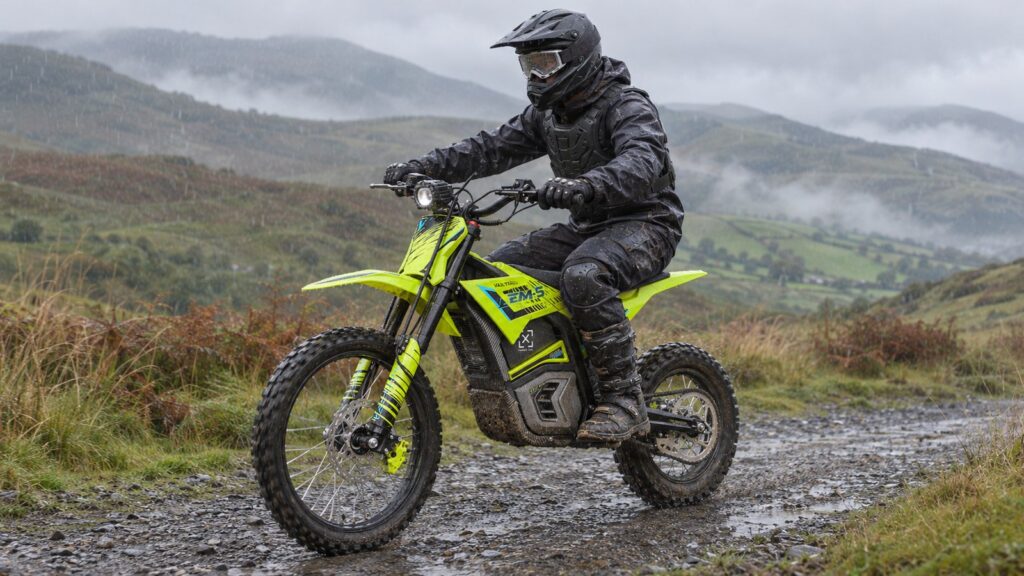
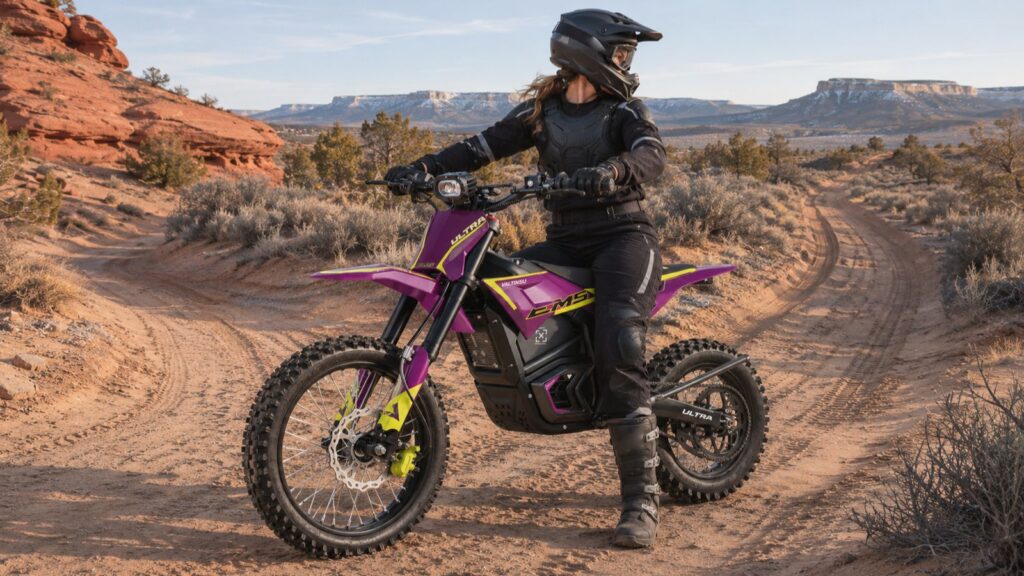
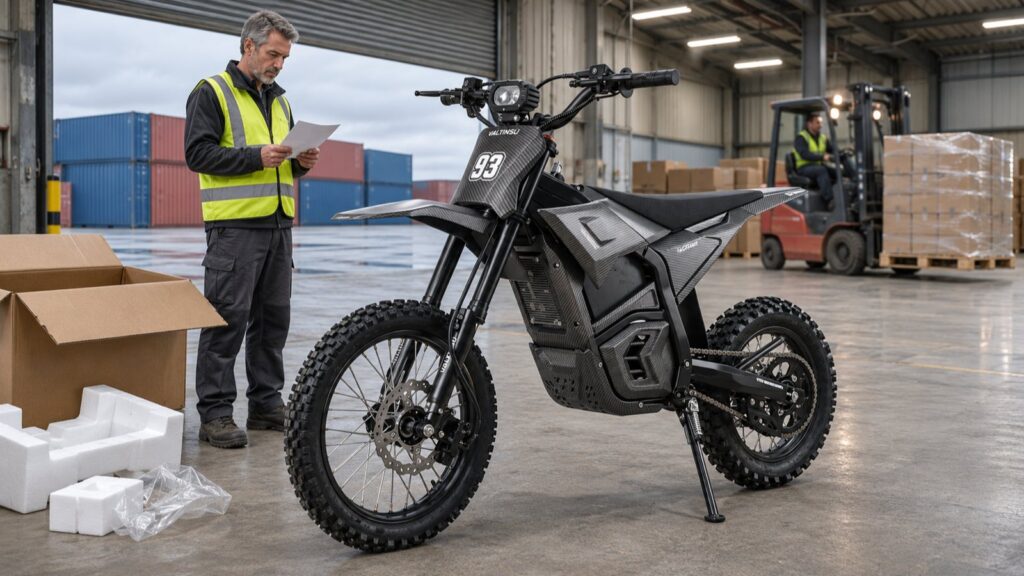
Voltage alone does not decide an electric dirt bike’s speed, torque or range. The EM-5, EM-5 Pro and EM-5 Ultra combine 48V, 60V and 72V batteries with different motors, controllers and chassis sizes. Dealers should compare rated power, battery energy, rider fit and documented test conditions before choosing models.
Volts, amp-hours and watt-hours in plain words
V
Volts are electrical pressure. Voltage alone does not set motor torque.
Ah
Amp-hours are like the size of the tank.
Wh
Watt-hours are the total energy in the battery. Multiply volts by amp-hours to get it.
Watts (W) are the power the motor delivers at a given moment. Peak watts are short bursts; rated watts are what it can hold.
| Model | Volts | Amp-hours | Energy (V × Ah) | Rated range |
|---|---|---|---|---|
| EM-5 | 48 V | 23.4 Ah | about 1,120 Wh | 50 mi (80 km) |
| EM-5 Pro | 60 V | 27 Ah | about 1,620 Wh | 59 mi (95 km) |
| EM-5 Ultra | 72 V | 25 Ah | about 1,800 Wh | 75 mi (120 km) |
Two batteries with the same watt-hours hold the same energy. At the same electrical power, a higher battery voltage means lower current; with the same wiring, that cuts wiring losses. Controller and motor temperatures still depend on their design and use, and how hard the bike pulls depends on the motor and controller.
Real numbers: our EM-5 series
This table compares the listed specs of three complete EM-5 models [1][2][3]. Their motors, controllers, battery capacity, wheels and weight also differ, so the table does not isolate the effect of voltage.
AT A GLANCE
Bars compare each row.
The highest value has the
longest bar.
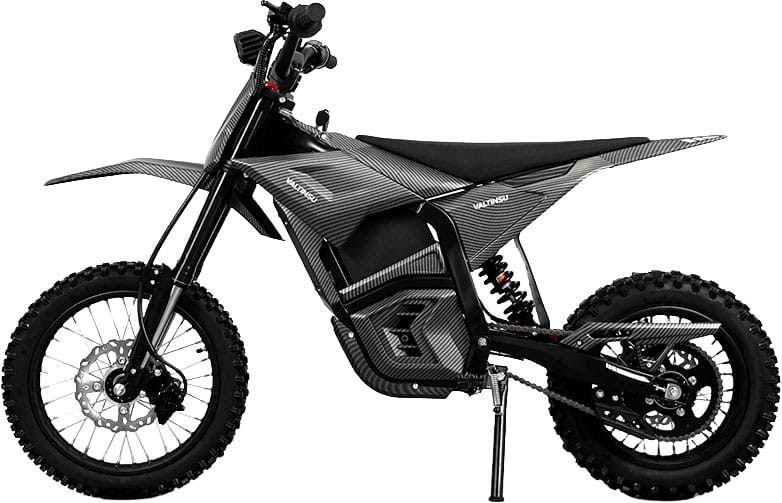
EM-5
48 V
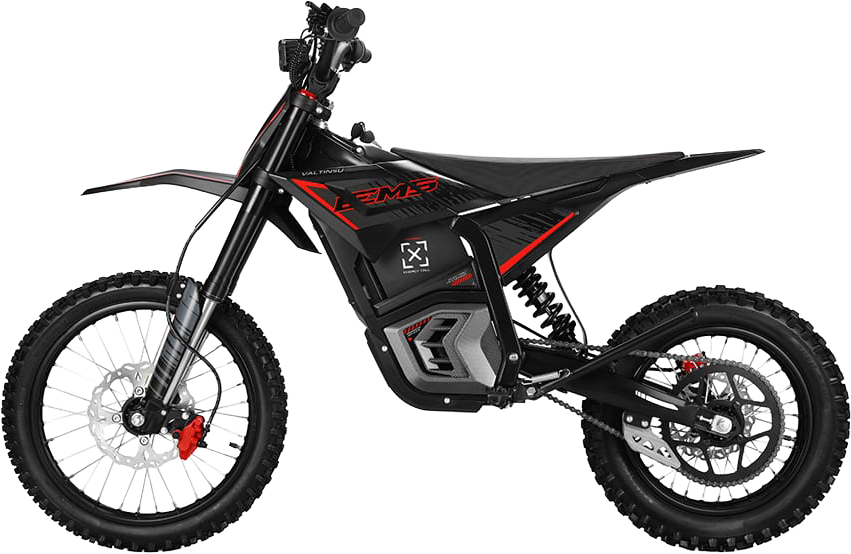
EM-5 Pro
60 V
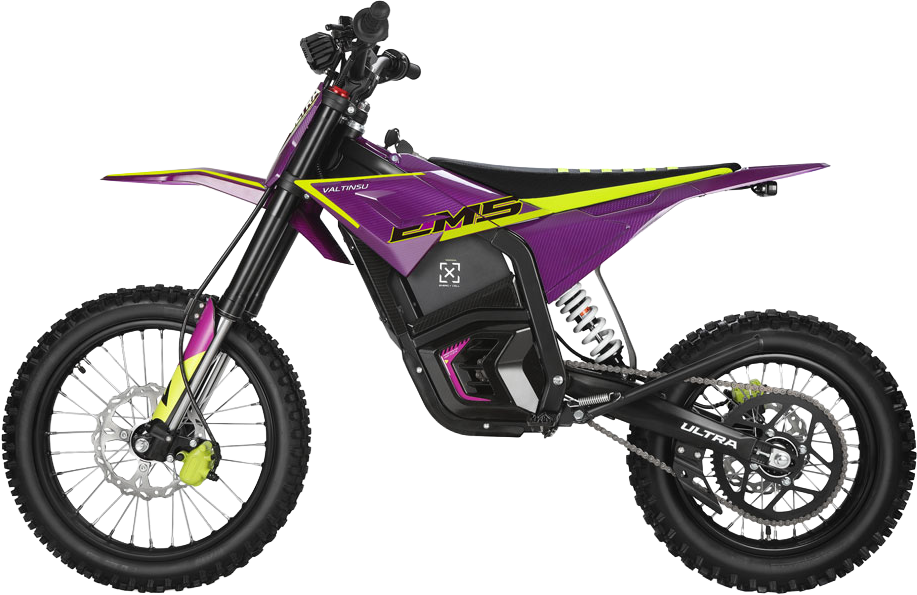
EM-5 Ultra
72 V
BATTERY
48 V 23.4 Ah
60 V 27 Ah
72 V 25 Ah,
Samsung cells
~1,120 Wh
~1,620 Wh
~1,800 Wh
50 mi (80 km)
59 mi (95 km)
75 mi (120 km)
POWER
3,840 W / 1,200 W
5,600 W / 2,500 W
8,000 W / not listed
200 N·m
240 N·m
275 N·m
40 mph (65 km/h)
52 mph (83 km/h)
56 mph (90 km/h)
CHASSIS
14 / 12 in
17 / 14 in
17 / 14 in
720 mm
800 mm
800 mm
110 kg (243 lb)
130 kg (287 lb)
130 kg (287 lb)
OTHER
36 / 52 / 65 km/h
42 / 64 / 83 km/h
48 / 68 / 90 km/h,
plus reverse
7–8 hours
7–8 hours
7–8 hours
IPX6
IPX6
IPX6
57 kg (126 lb)
65 kg (143 lb)
65 kg (143 lb)
Note: Battery energy is volts × amp-hours, worked out from our battery specs. Confirm how torque is measured before comparing these figures with other bikes. Range is our rated figure. Real range depends on rider weight, terrain, temperature and riding mode.
We also build the EM23, a second 60V model with bigger 19 in / 17 in wheels, 4,000 W peak power, about 250 N·m of torque and a 70 km/h (43.5 mph) top speed [4]. It suits adults who want a full-size stance more than outright speed. Its water rating is IPX4, so it is less suited to wet riding than the EM-5 series.
EM-5 series · rated specs
LONGER BAR = MORE
Peak power
watts
EM-5 · 48 V
3,840 W
Pro · 60 V
5,600 W
Ultra · 72 V
8,000 W
Max torque
N·m
EM-5 · 48 V
200 N·M
Pro · 60 V
240 N·M
Ultra · 72 V
275 N·M
Top speed
km/h
EM-5 · 48 V
65 KM/H
Pro · 60 V
83 KM/H
Ultra · 72 V
90 KM/H
Rated range
km
EM-5 · 48 V
80 KM
Pro · 60 V
95 KM
Ultra · 72 V
120 KM
Battery energy
watt-hours
EM-5 · 48 V
~1,120 WH
Pro · 60 V
~1,620 WH
Ultra · 72 V
~1,800 WH
Peak power, torque, top speed, rated range and battery energy on our EM-5 series. Battery energy is volts × amp-hours. Source: VALTINSU EM-5 series spec sheets.
Numbers only go so far. This clip puts the 48V and 60V bikes side by side with the same rider.
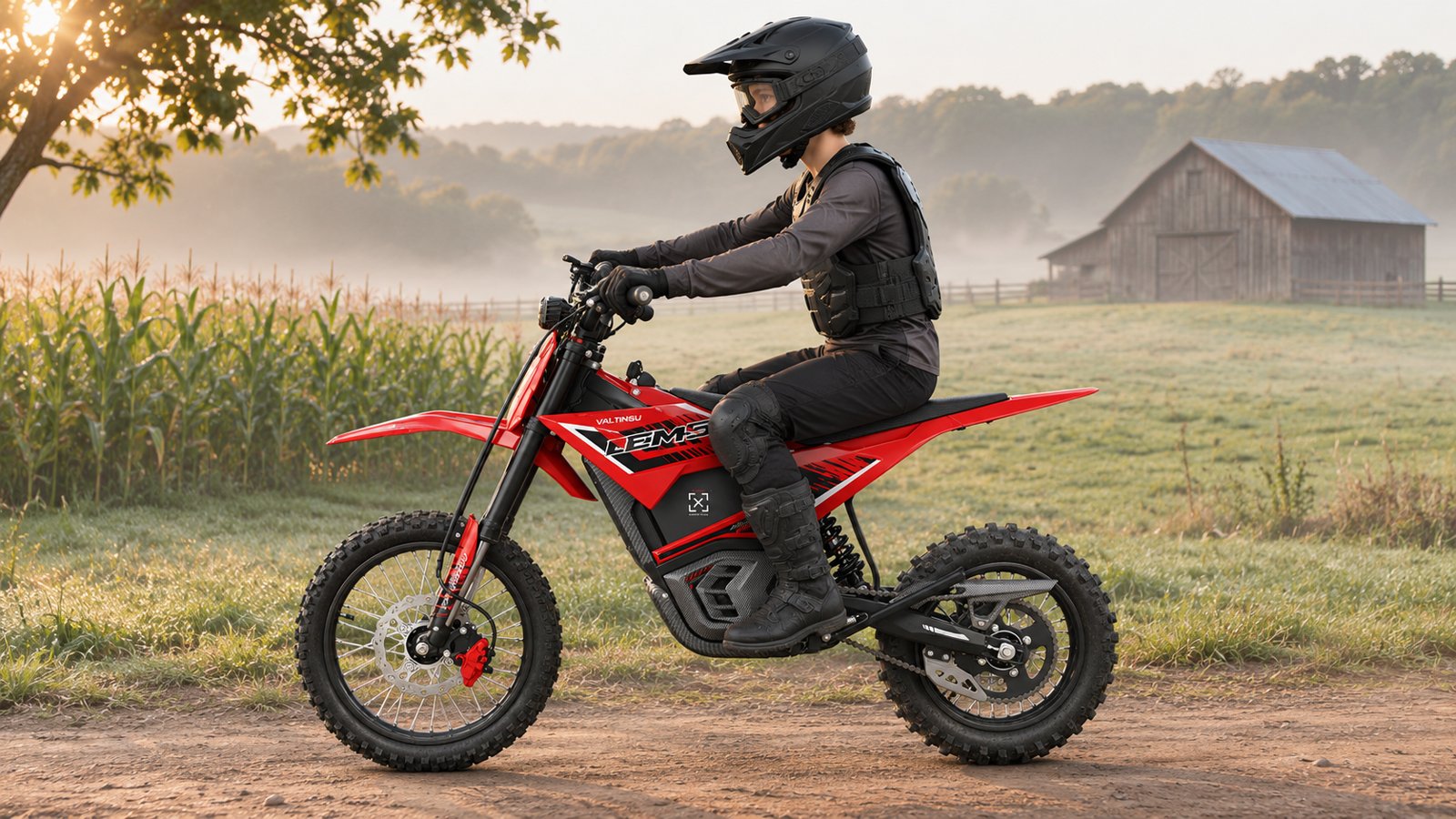
EM-5 and EM-5 Pro: seat height and rider fit
Compare the EM-5 and EM-5 Pro seat height, riding position and wheel size with the same rider. This clip shows rider fit; it is not a controlled performance test. · YouTube
Energy per kilometer of rated range
Dividing battery energy by rated range gives a simple ratio. It is arithmetic, not a measured consumption figure:
| Model | Battery energy | Rated range | Energy per km (rated) |
|---|---|---|---|
| EM-5 (48V) | about 1,120 Wh | 80 km | about 14 Wh/km |
| EM-5 Pro (60V) | about 1,620 Wh | 95 km | about 17 Wh/km |
| EM-5 Ultra (72V) | about 1,800 Wh | 120 km | about 15 Wh/km |
Note: Rated ranges are not all tested under the same conditions, so use this as a rough guide, not an efficiency ranking. Hard riding in the top mode uses far more energy per kilometer.
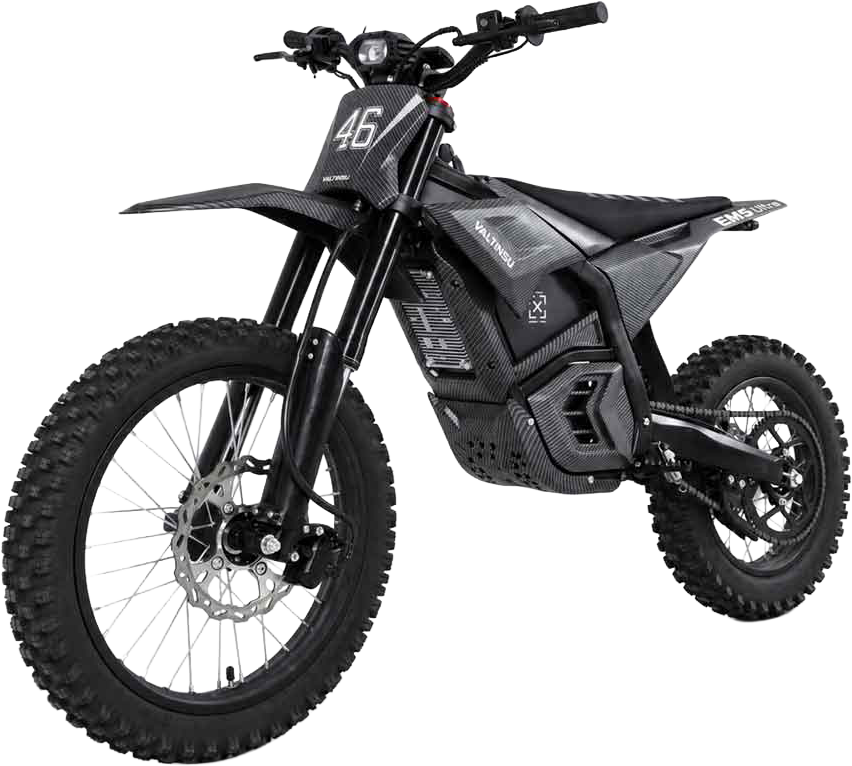
EM-5 SERIES
See all three models side by side
Compare the EM-5, EM-5 Pro and EM-5 Ultra on one page: battery, power, range and rider fit.
What changes on the trail as voltage goes up
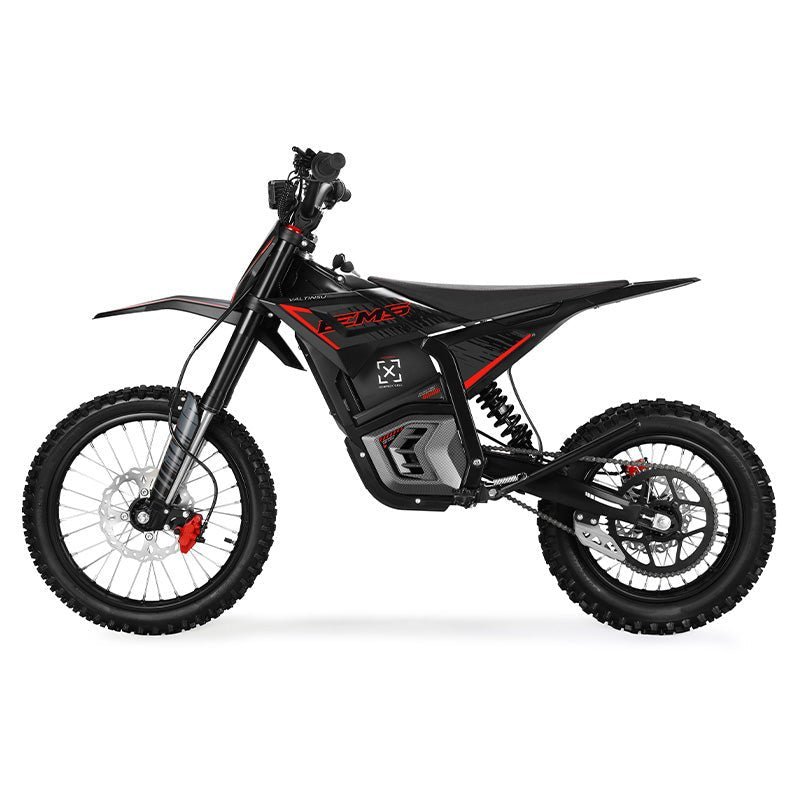
PULL AND ACCELERATION
275N·m
FROM 200 N·M ON 48 V
On our EM-5 series, the higher-voltage models also have more listed peak power and torque: from 200 N·m on the EM-5 to 275 N·m on the Ultra. For a new rider, that extra pull can be too much at first, which is why every EM-5 model has a low riding mode.
TOP SPEED
56mph
FROM 40 MPH ON 48 V
Top speed climbs from 40 mph on the 48V EM-5 to 56 mph on the 72V Ultra. For adults who want around 50 mph, the 60V EM-5 Pro lists 52 mph and the Ultra 56 mph. Speed depends on rider weight, terrain and mode, so treat top speed as a ceiling, not a cruising speed (see our top speed guide).
HEAT
Lesscurrent
SAME POWER, HIGHER VOLTAGE
At the same electrical power, a higher-voltage system draws less current, which cuts losses in the wiring. Controller and motor temperatures on long, hard rides still depend on their design, limits and cooling.
SIZE AND WEIGHT
800mm seat
FROM 720 MM ON 48 V
Higher-voltage bikes often come on larger frames. The Pro and Ultra use 17 in / 14 in wheels and an 800 mm seat. The 48V EM-5 uses 14 in / 12 in wheels and a 720 mm seat and weighs 57 kg, which suits smaller riders.
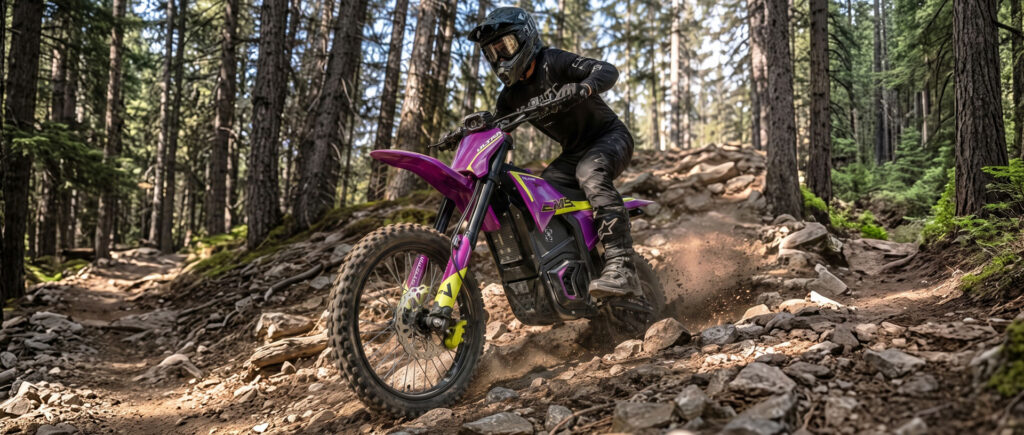
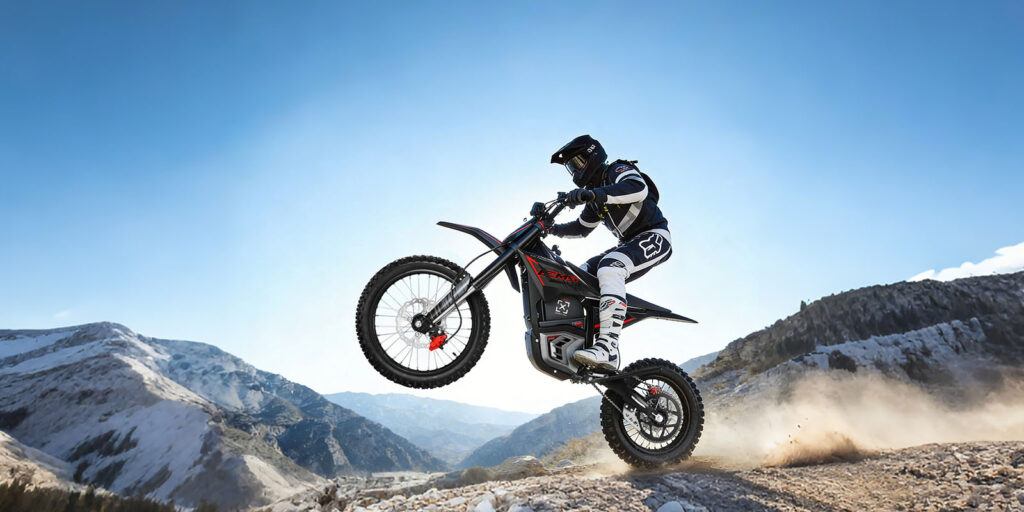
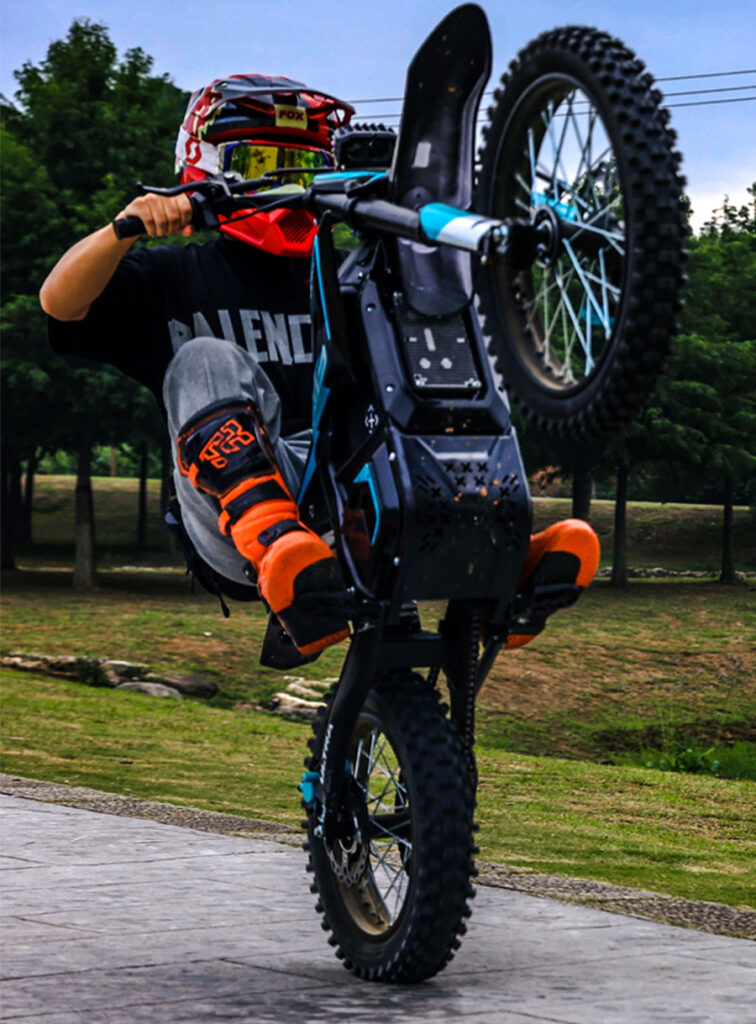
Left: EM-5 Ultra on a rocky forest trail. Top right: EM-5 Pro in the air. Bottom right: EM-5 Ultra front wheel up.
How riding modes change the picture
Each EM-5 model has three riding modes that cap top speed. That makes a higher-voltage bike more usable for a growing or learning rider, because the mode, not the battery, sets how fast the bike can go.
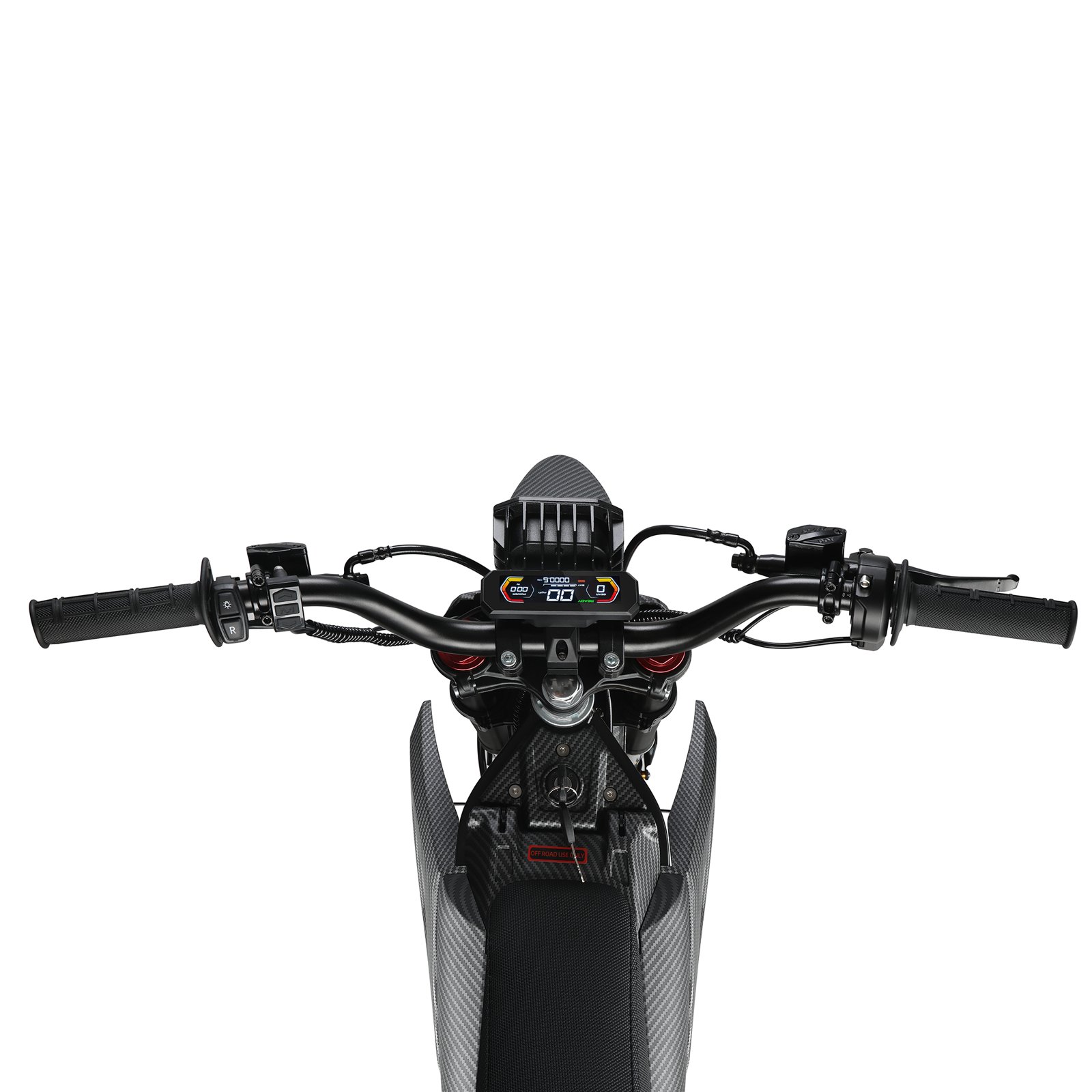
Low mode is for lower-speed riding by riders who meet the model’s age, fit and skill requirements. Middle mode suits trail riding. High mode is for experienced riders on open sections.
Modes cap top speed, not the whole character of the bike. The Ultra’s low mode still allows 48 km/h, so it is not a first bike for a beginner.
How each voltage compares with gas bikes
Riders moving from gas often ask what an electric bike “feels like” in engine terms. There is no exact match, because an electric motor delivers its torque from a standstill, but size class and seat height give a rough guide:
| Model | Closest gas size class (by frame and seat) | Main difference |
|---|---|---|
| EM-5 (48V) | 110cc to 125cc pit bike | Quieter; no gears to learn |
| EM-5 Pro (60V) | 125cc to 150cc on a larger frame | Low-speed response depends on the mode and controller settings |
| EM-5 Ultra (72V) | Larger pit bike or small full-size bike | Reverse gear; no combustion-engine service, but tires, brakes, chain and suspension still need care |
Note: These are size comparisons, not performance equivalences. Acceleration depends on the specific models, gearing and test conditions. Electric bikes avoid engine-oil and fuel-system servicing but still need brake, tire, chain, bearing and battery maintenance. Compare charging time, replacement battery cost and parts availability alongside the purchase price.
Which voltage fits which rider
3 MODELS · 1 SERIES
For first-time riders
48 V
EM-5
48 V 23.4 Ah · about 1,120 Wh
65
km/h top speed
200
N·m torque
720
mm seat height
GOOD FOR
Teens (13+) and smaller adults on their first electric dirt bike.
TRADE-OFF
Smaller 14 / 12 in wheels and a 110 kg rider limit. Taller riders will outgrow it.
For most adult riders
60 V
EM-5 Pro
60 V 27 Ah · about 1,620 Wh
83
km/h top speed
240
N·m torque
800
mm seat height
GOOD FOR
Adults (listed 18+) riding trails and backyard tracks who want a full-size frame.
TRADE-OFF
A full charge takes about 7 to 8 hours.
For experienced riders
72 V
EM-5 Ultra
72 V 25 Ah, Samsung cells · about 1,800 Wh
90
km/h top speed
275
N·m torque
120
km rated range
GOOD FOR
Riders who want the strongest pull, the longest rated range and a reverse gear.
TRADE-OFF
8,000 W peak is a lot for a first bike. Start new riders in the low mode.
Note: Listed ages are the manufacturer’s guidance, not a fit check. Look at the rider’s reach, balance, braking and skill, and supervise riders under 18 in full protective gear.
Choose by rider, not by top speed. Heavier riders, close to 130 kg (287 lb), should look at 60V or 72V for the higher load rating and more torque on climbs. Always start from the age rating.
What each model has
EM-5
48 V
EM-5 Pro
60 V
EM-5 Ultra
72 V
Three riding modes

Reverse mode
—
—
720 mm seat for smaller riders
—
—
Full-size 17 / 14 in wheels
—
130 kg max rider load
—
Over 100 km rated range
—
—
From our EM-5 series specs.
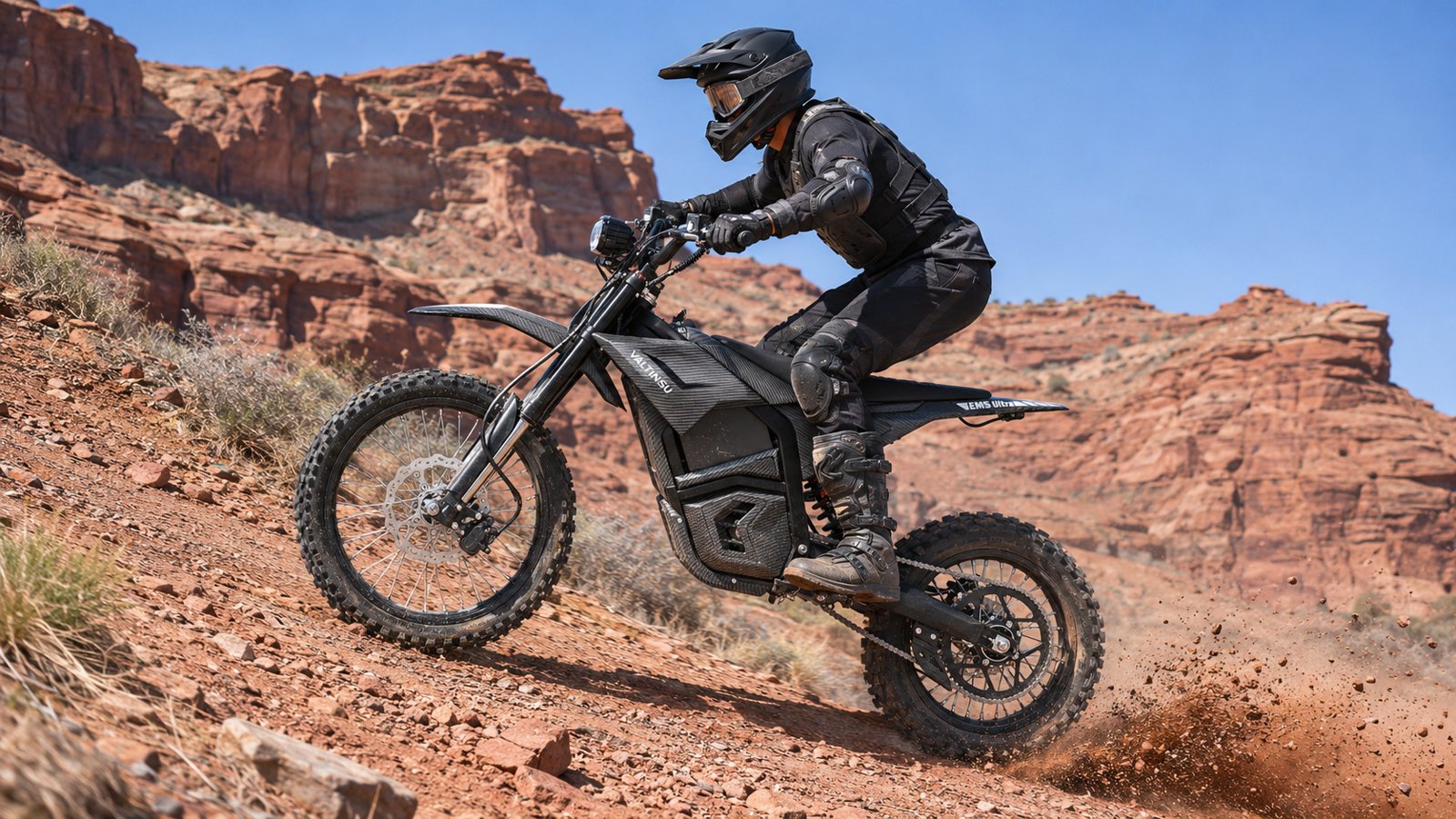
For younger riders, start with the age rating. Our EM-5 is rated for riders 13 and over. For younger riders, look at our youth models and always follow the age rating.
Example scenario
Example: a 75 kg adult riding mostly on a private woodland trail with some steep climbs might look at the 60V EM-5 Pro, for its listed torque, full-size seat and top speed. For riders aged 13 to 17, confirm physical fit and riding ability, follow the model’s age guidance, and require direct adult supervision and protective gear. The EM-5’s 36 km/h low-mode limit does not by itself make it a beginner bike.
How fast is a 72V electric dirt bike?
Voltage alone does not set top speed. We list the 72V EM-5 Ultra at up to 56 mph (90 km/h) in its high mode, with 30 and 42 mph in the lower modes and a reverse gear [3]. Actual speed depends on rider load, terrain, battery charge and riding mode. For a full speed breakdown by model, see our top speed guide.
Charging and battery life
Charging time depends on battery size and charger output. Our listings give about 7 to 8 hours for all three EM-5 models on their standard chargers [1][2][3]. Always use the charger supplied for the model.
Riders often ask how long an electric dirt bike battery lasts. Two things matter: how far one charge goes (range) and how many years the battery keeps its capacity. Battery life depends on charging habits, storage and temperature. Our maintenance guide explains how to store and charge the battery to keep it healthy.
Weather and temperature
Cold weather can reduce battery performance and riding range [5]; that source describes electric cars, not EM-5 test results. Follow the model manual for charging temperatures and storage conditions, and store the bike and battery indoors when it is not in use. We list all three EM-5 models as IPX6 and advise avoiding deep water, pressure washing and long periods of heavy rain [6] (see our guide to riding in the rain).
What to confirm before ordering 72V or 60V models
Product pages for 72V bikes lead with price, stock and delivery. For a dealer order, ask for the same things in writing: a model-specific quote for your market and quantity, the minimum order, production and delivery lead time, the exact configuration (battery, charger output, controller and display), the spare parts list and the written dealer warranty terms. Then compare models side by side and request a dealer quote.
Questions to ask a supplier about voltage and batteries
| Question | Why it matters |
|---|---|
| Which cells are in the battery? | Cell quality affects range, power and life. Our EM-5 Ultra uses Samsung cells. |
| What does the battery management system protect against? | Over-charge, over-discharge and overheating protection keep the pack safe. |
| What is the charger output and charging time? | Tells you real turnaround between rides. |
| Are spare batteries and chargers available? | Riders and rental fleets often want a second battery. |
| Which battery documents are on file? | Request the UN 38.3 test summary for the exact battery model supplied [7]. An SDS is not a substitute for it or a universal transport requirement. Confirm the classification, packaging, labels and documents for complete bikes and spare batteries with your freight forwarder. |
| What does the warranty cover on the battery? | Our US retail policy lists a 12-month battery warranty, subject to its exclusions [8]. Ask for separate written dealer terms covering parts, labour, freight and claim handling before ordering. |
Common mistakes
THE MISTAKE
WHAT ACTUALLY HAPPENS
Buying the highest voltage for a new rider.
Voltage alone does not decide pull, and a stronger bike is not a safer one.
Comparing voltage without battery size.
Range comes from watt-hours, not volts alone.
Mixing chargers between models.
Chargers are built for one voltage.
Fitting a higher-voltage battery to a lower-voltage bike.
It can damage the motor and controller and is a safety risk.
Expecting rated range at full speed.
Hard riding cuts range sharply.
Where you can ride
The EM-5 series is sold for off-road use. Whether an electric dirt bike can ride on public roads depends on the country, and in the US and Canada on the state or province. Our license guide covers it market by market.
Notes for dealers
For dealers
- Build your model mix around customer age, rider fit, terrain and expected service demand. Before ordering, ask for model-specific quotes, minimum order quantities, lead times, spare parts lists, battery documents and written dealer warranty terms.
- Chargers and batteries are voltage-specific. Keep the right charger and common spares for each model in stock.
- Ask riders about their height, weight and experience before talking about top speed.
- Use the riding modes in demos: let customers try the low mode first.
Stocking checklist
MODEL
BATTERY AND CHARGER
CHARGING TIME
MAX LOAD
EM-5
48 V 23.4 Ah
48 V CHARGER
7–8 hours
110 kg
EM-5 Pro
60 V 27 Ah
60 V CHARGER
7–8 hours
130 kg
EM-5 Ultra
72 V 25 Ah
72 V CHARGER
7–8 hours
130 kg
Chargers and batteries are voltage-specific. Check off each model as you place the order.
EM-5 Ultra colors


Studio photos of the EM-5 Ultra in its four colors.
See all three side by side on our EM-5 comparison page, or ask for dealer pricing.
FAQ
What is the difference between a 48V, 60V and 72V electric dirt bike?
The difference between 48V, 60V and 72V electric dirt bikes starts with voltage, which is electrical pressure. Together with amp-hours it sets how much energy the battery holds, but it does not on its own set torque or speed: the motor, controller and gearing do that.
On our EM-5 series the higher-voltage models also have more listed power:
- 48V EM-5: 3,840 W listed peak power.
- 60V EM-5 Pro: 5,600 W listed peak power.
- 72V EM-5 Ultra: 8,000 W listed peak power.
Range comes from watt-hours and riding conditions.
Is a 72V electric dirt bike better than a 60V one?
A 72V electric dirt bike is stronger on paper than a 60V one, not better for everyone.
| Listed figure | 60V EM-5 Pro | 72V EM-5 Ultra |
|---|---|---|
| Peak power | 5,600 W | 8,000 W |
| Torque | 240 N·m | 275 N·m |
The Ultra also has a longer listed range and a reverse gear. Those figures come from different motors and controllers, not voltage alone. Choose by the rider's experience, fit and riding area.
Can I put a 72V battery on a 48V bike?
No. You cannot put a 72V battery on a 48V electric dirt bike, because the motor, controller, charger and wiring are built for one battery.
- Damage: a different battery can overheat or damage the controller and motor.
- Fire: a mismatched battery is a fire risk.
- Warranty: our US retail warranty excludes damage caused by non-Valtinsu batteries and says unauthorized modifications void the controller warranty.
Dealer terms are set in the dealer agreement. Choose the model you need from the start.
Does higher voltage mean more range?
Higher voltage does not mean more range on its own. Range depends on the battery's total energy in watt-hours, plus rider weight, terrain, temperature and riding mode. On our bikes the higher-voltage models also carry larger packs:
| Model | Battery energy | Rated range |
|---|---|---|
| 48V EM-5 | About 1,120 Wh | 50 miles |
| 60V EM-5 Pro | About 1,620 Wh | 59 miles |
| 72V EM-5 Ultra | About 1,800 Wh | 75 miles |
How fast is a 72V electric dirt bike?
Voltage alone does not set top speed. We list our 72V EM-5 Ultra at up to 56 mph (90 km/h) in the high mode, with lower modes of 30 and 42 mph. Actual speed depends on rider load, terrain, battery charge and the mode selected. Other 72V bikes can be set up very differently, so compare listed speeds per mode, max load and range.
How fast is a 60V electric dirt bike?
A 60V electric dirt bike's speed depends on the model.
- 60V EM-5 Pro: lists 26, 40 and 52 mph in its three modes.
- 60V EM23: lists 43.5 mph on bigger 19 in / 17 in wheels.
Same voltage, different results, because the motor, controller and gearing differ. Rider weight and hills decide how close you get to the top figure.
How long does it take to charge a 48V, 60V or 72V bike?
Our listings give about 7 to 8 hours for all three EM-5 models on their standard chargers, even though the batteries differ in size. Always use the charger supplied for the model, because chargers are built for one voltage. Let a hot battery cool before charging and never charge below freezing.
Which voltage is right for a 12 or 13-year-old?
For a 12 or 13-year-old, start with the age rating, then check fit.
- Check the maker's age rating: our 48V EM-5 is listed for riders 13 and over, so it is not for a 12-year-old.
- Choose a model whose maker explicitly allows the rider's age.
- For riders 13 to 17, check reach, balance and skill.
- Require adult supervision and protective gear.
The 60V EM-5 Pro is listed for riders 18 and over.
Is 48V enough for an adult?
For a lighter adult on tight tracks it can be. The EM-5 lists a 110 kg (243 lb) max load and 40 mph. Heavier riders, riders who climb a lot and riders who want a full-size seat should compare the 60V EM-5 Pro and 72V EM-5 Ultra, which list a 130 kg (287 lb) max load and a 45° maximum climbing angle, measured under undisclosed conditions.
Do electric dirt bikes lose range in winter?
Yes. Lithium batteries deliver less in the cold, and the US Department of Energy reports the same for electric vehicles in general. Expect shorter rides on cold days, store the battery indoors at room temperature and never charge below freezing. Charging a frozen battery is excluded from our retail battery warranty.
References
- VALTINSU EM-5 Off-Road Electric Dirt Bike: specifications. VALTINSU (valtinsusport.com). https://valtinsusport.com/products/electric-off-road-adult-dirt-bike-em-5-with-light
- VALTINSU EM-5 Pro Off-Road Electric Dirt Bike: specifications. VALTINSU (valtinsusport.com). https://valtinsusport.com/products/electric-off-road-adults-black-advanced-dirt-bike-em-5-pro-for-sale
- VALTINSU EM-5 Ultra Electric Dirt Bike: specifications. VALTINSU (valtinsusport.com). https://valtinsusport.com/products/em-5-ultra-72v-8000w-electric-dirt-bike
- VALTINSU EM23 Electric Dirt Bike: specifications. VALTINSU (valtinsusport.com). https://valtinsusport.com/products/electric-off-road-adult-dirt-bike-em23
- Fuel Economy in Cold Weather. U.S. Department of Energy and EPA (fueleconomy.gov). https://www.fueleconomy.gov/feg/coldweather.shtml
- FAQs. VALTINSU (valtinsusport.com). https://valtinsusport.com/pages/faqs
- Lithium Battery Guidance Document 2026. IATA. https://www.iata.org/contentassets/05e6d8742b0047259bf3a700bc9d42b9/lithium-battery-guidance-document.pdf
- Warranty Policy. VALTINSU (valtinsusport.com). https://valtinsusport.com/pages/warranty-policy
About this guide
Every number here comes from our own spec sheets. We do not report ride tests we have not run. Rated figures are marked.
Update history