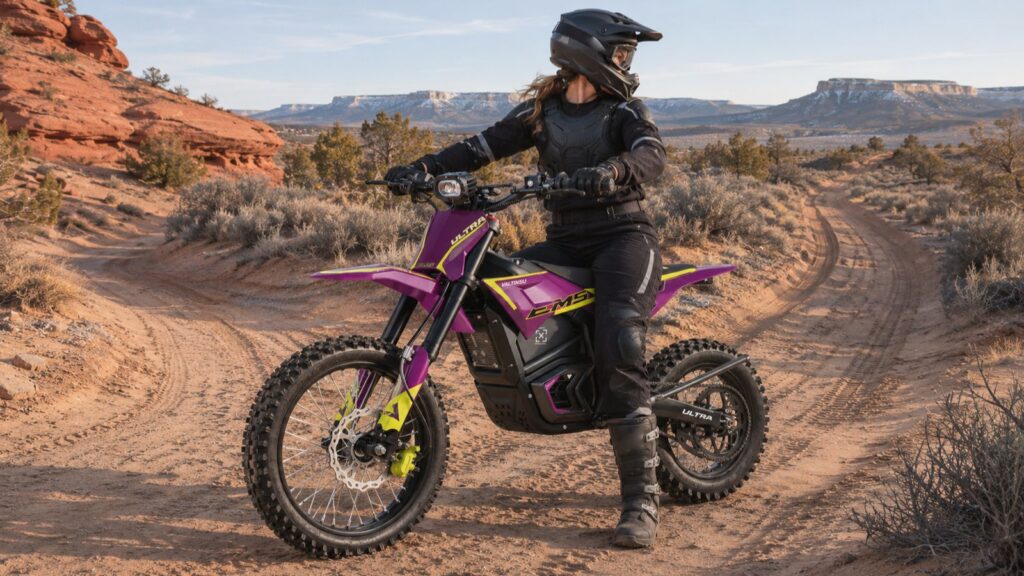
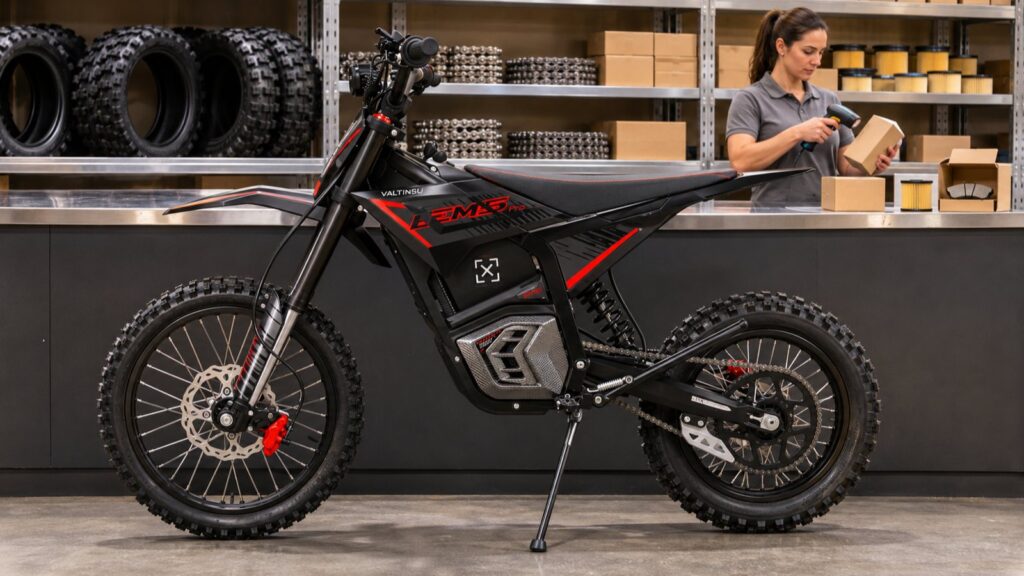
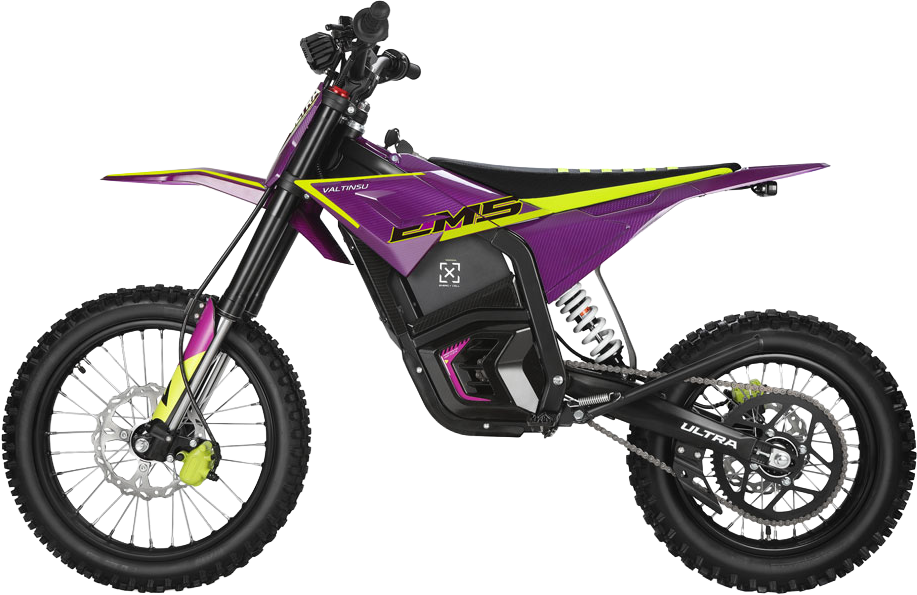
Yes, you can ride an electric dirt bike in light to moderate rain if it has a water rating such as IPX4 or IPX6. Our EM-5, EM-5 Pro and EM-5 Ultra are rated IPX6, which covers rain and strong splashes. No rating on our bikes covers riding through deep water, sitting in a flood or pressure washing.
Water ratings are easy to misread. This guide explains what the IPX numbers mean, what each one can and cannot handle on the trail, how to wash the bike, and what to do after a wet ride.
What IPX means
IP ratings come from the international standard IEC 60529 [1]. The first digit is protection against dust and solids; the second is protection against water. An X in the first place means the product was not rated for dust, so IPX6 is a water rating only. IPX4 covers splashing water, while IPX6 covers powerful water jets. IPX7 and IPX8 deal with immersion under set conditions and do not on their own show resistance to water jets. None of these ratings sets a motorcycle’s permitted wading depth.
| Rating | Test in plain words | What it means on a dirt bike |
|---|---|---|
| IPX4 | Water splashed from any direction | Light rain and splashes from puddles |
| IPX5 | Water jets from any direction | Heavier spray from the front wheel |
| IPX6 | Powerful water jets from any direction | Heavy rain and strong splashes; does not cover immersion |
| IPX7 | Temporary immersion in water | Immersion under test conditions only; not a wading depth |
| IPX8 | Continuous immersion, conditions set by the maker | Rare on dirt bikes |
Note
These are lab tests on a new product. Seals age, connectors get knocked and mud packs into gaps, so real-world protection drops over time. A rating is not a promise that water can never get in.
Water ratings across our range
| Model | Water rating | What it handles |
|---|---|---|
| EM-5 (48V) | IPX6 | Rain and strong splashes |
| EM-5 Pro (60V) | IPX6 | Rain and strong splashes |
| EM-5 Ultra (72V) | IPX6 | Rain and strong splashes |
| EM23 (60V) | IPX4 | Light rain and splashes |
The clip below is a quick visual of the EM-5 Pro’s details. Keep the limits in the next table in mind: a rating covers rain and splashes, not deep water.
95KM Range & IPX6 Waterproof? The EM-5 PRO is UNREAL! Full Detail Showcase
28-second detail showcase of the EM-5 Pro (60V), including its IPX6 rating and 95 km rated range. The video title says waterproof; IPX6 means water resistant to jets, not sealed for immersion. · YouTube
Note
Our published retail specifications list the EM-5, EM-5 Pro and EM-5 Ultra as IPX6 and the EM23 as IPX4 [2][3][4][7]. These are manufacturer-declared ratings; before using them in dealer materials, confirm the tested assembly and the export configuration. Our FAQ page also advises avoiding deep water, flooding, heavy rain and high-pressure washing [5].
How to check which parts an IP rating covers
Match each IP code to the part named in the manual before you put it on a dealer listing. IEC 60529 rates the enclosure around electrical equipment. A single bike can have several different ratings. Segway’s X160 and X260 manual, for example, lists IP65 for the battery and motor, IP67 for the controller and IP55 for the connections. A listing that says only “IP67” loses the detail a buyer needs. [8] [9]
| What the supplier sheet says | What to check before publishing |
|---|---|
| A code beside one part | Keep the part name beside the number. In the Segway example, “IP67 controller” is accurate. The manual gives the battery its own entry. [9] |
| A rating for a mated connector | Mated means the plug and socket are joined. Rosenberger specifies this condition for its RoPD connector. Ask what protection applies when the plug is out or a cap is fitted. [10] |
| One code beside the bike name | Ask us which assembly the code covers on the export model you plan to sell. If the charger or charge port is missing from the answer, leave its rating blank. [8] [10] |
Riding in the rain: what is fine and what is not
| Situation | IPX6 bike (EM-5 series) | IPX4 bike (EM23) |
|---|---|---|
| Light rain | Fine | Fine |
| Heavy rain for a short ride | Avoid; follow the manual | Avoid; follow the manual |
| Riding all day in heavy rain | Avoid | Avoid |
| Water of unknown depth | Do not ride through | Do not ride through |
| Water up to the motor or battery case | Do not ride through | Do not ride through |
| Stream or river crossing | Do not ride through | Do not ride through |
| Bike left standing in floodwater | Do not ride; have it checked | Do not ride; have it checked |
Two things are often missed. First, speed matters: hitting a puddle fast throws water up at the motor, controller and connectors much harder than any rain. Slow down. Second, mud holds water against the bike for hours after the rain has stopped. Clean it off the same day.
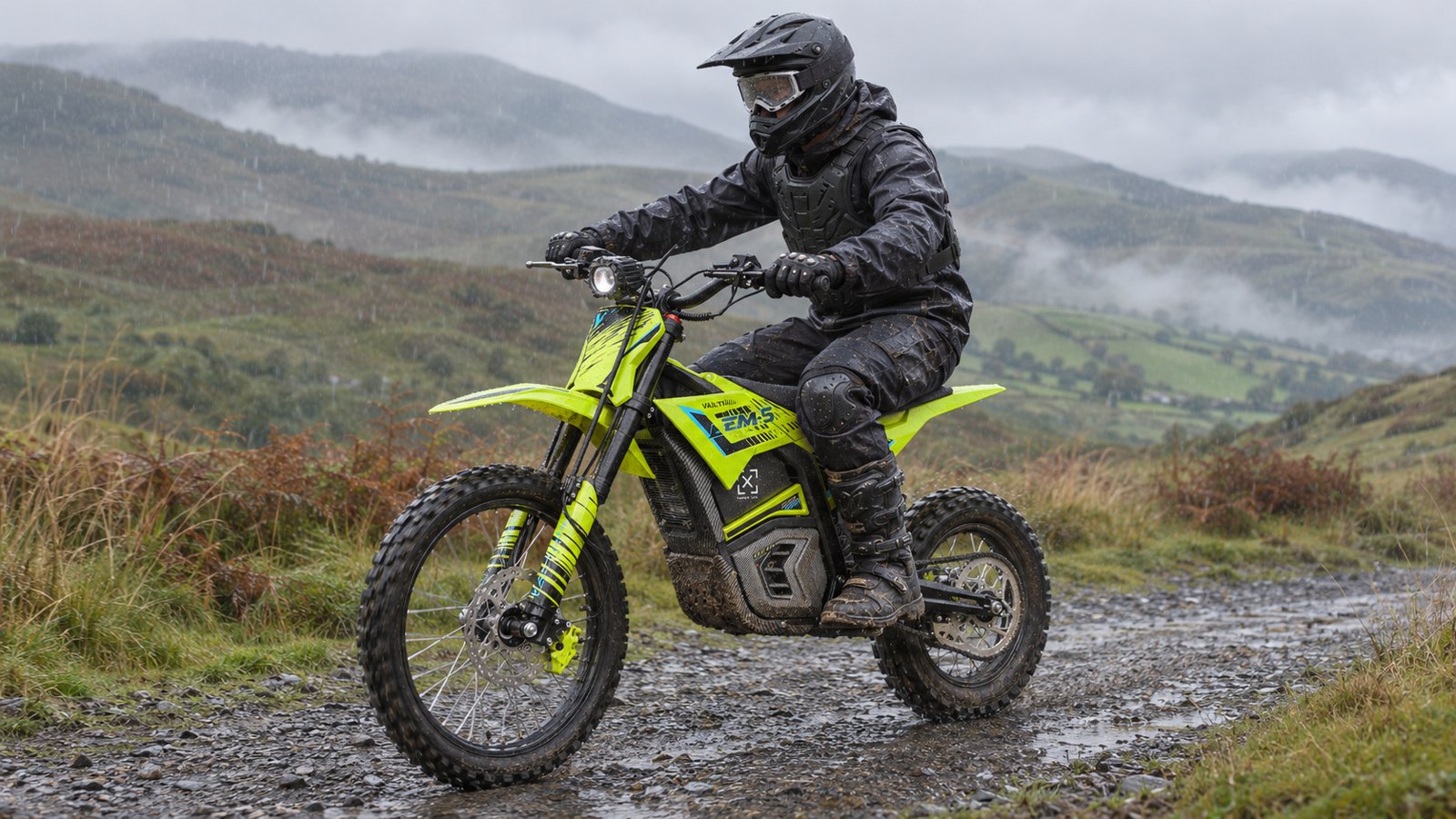
How to brake on a wet trail and check the brakes afterward
Slow down before a wet bend and leave more room to stop. Rain can reduce the grip between the tires and the trail. Water on the brakes can also weaken their response for a short time, including after a wash. A rider can encounter either problem on the first turn out of the yard. [11] [12]
- On the approach, ease off the throttle early and widen the gap to the rider ahead. Choose your speed while the bike is still upright. Wet leaves and wooden surfaces deserve extra room. [11] [12]
- When slowing down, use both brakes and build pressure gradually. Keep steering and throttle changes smooth. A sudden change of speed or direction can start a skid on a slippery surface. [11] [12]
- After an ordinary wash, check the brakes at low speed in a clear, level area. HMW advises several gentle brake applications to help restore normal braking. Segway’s inspection procedure checks the front and rear brakes separately on a dry, flat surface. [9] [11]
- If either brake still feels weak, stop the check and arrange service before handing the bike back. A working rear brake can mask a weak front brake when both are applied together. [9] [11]
Can an electric dirt bike go through water?
Do not infer a safe wading depth from an IPX4 or IPX6 rating. Follow the model manual, avoid water of uncertain depth and do not attempt stream or river crossings. We have not published a maximum wading depth.
Water damage is also a warranty question. The retail warranty published on valtinsusport.com excludes motor damage from immersion and lists environmental damage, including rain, flooding, salt and sand [6]. Dealers should confirm the wholesale warranty in writing before making customer commitments. Explaining water-resistance limits does not change the warranty terms (see our warranty claim guide).
How to wash an electric dirt bike
- Turn the bike off, remove the key and close the charging port cover.
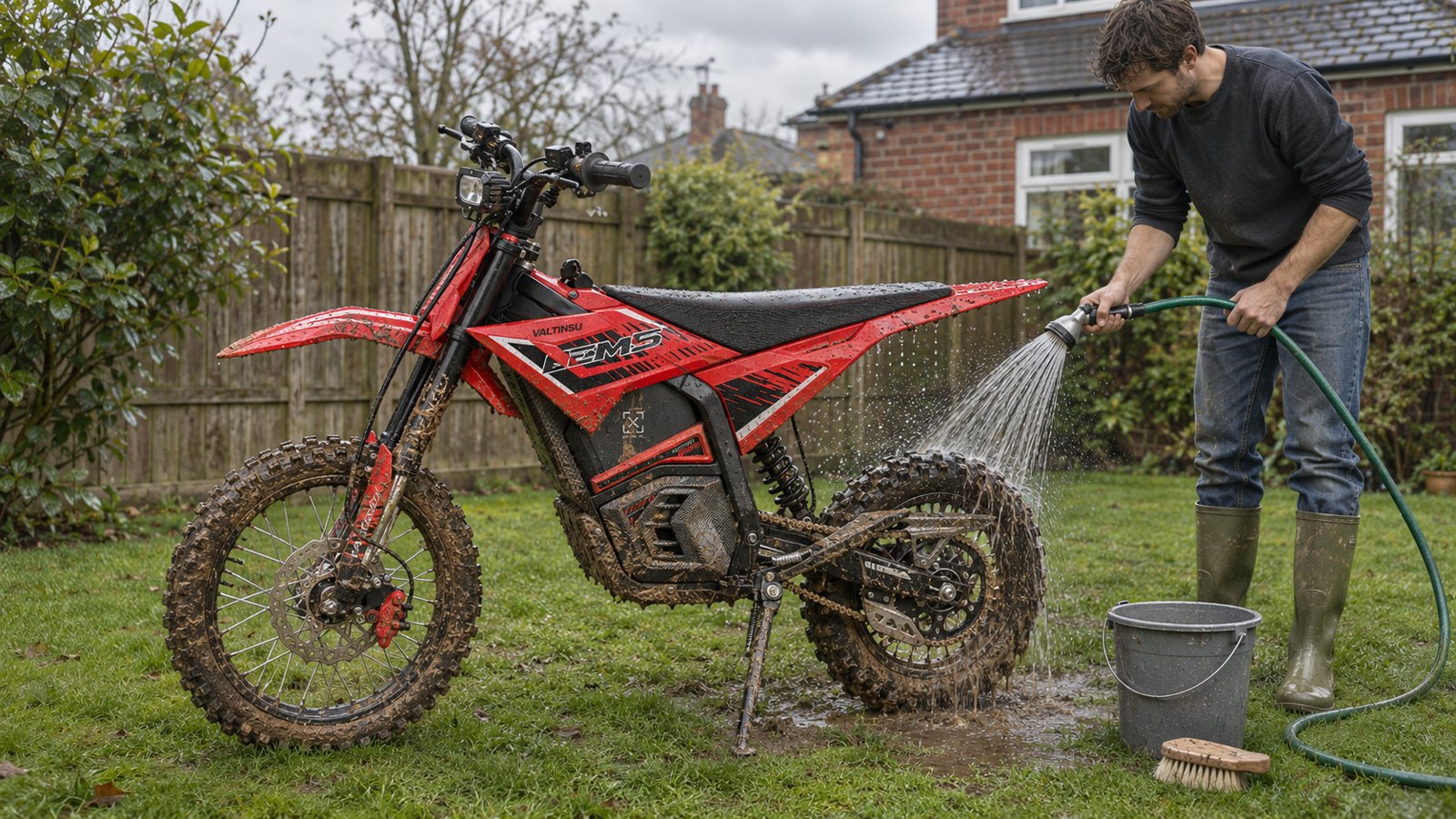
- Rinse with a garden hose on a gentle setting, or use a bucket and soft brush.
- Do not use a pressure washer. An IPX6 test uses water jets, not a high-pressure nozzle held close to seals and connectors.
- Keep water away from the battery case, controller, display and charging port.
- Dry with a cloth or let it air dry in the shade.
- Lube the chain after washing.
After a wet ride
| Step | Why |
|---|---|
| Wipe the bike down and clear mud from around the motor, controller and connectors | Mud traps water against seals |
| Charge only when the charging connection is completely dry and the manual’s checks are done | Charging with water in the port is a short-circuit risk |
| Lube the chain | Water washes the lube off and starts rust |
| Check brakes before the next ride | Wet grit wears pads fast |
| If the bike was submerged or water may have got inside, or you see fault codes, power cuts or a fogged display, do not ride or charge it | Have it checked by qualified service support |
Example scenario
Example (hypothetical): an adult rider takes an EM-5 Pro out on a forest loop in Oregon. Halfway round, heavy rain starts. They ride back slowly, slow down further for every puddle and skip a stream crossing. At home they hose off the mud at low pressure, check that the charging connection is completely dry and only then charge, following the manual. The chain gets lubed before the next ride.
What dealers should ask when a battery has been underwater
If a customer reports a submerged battery, ask first whether they can see smoke or hear hissing or popping from where they are. If they can, tell them to move away and call the local fire service from a safe place. Keep the bike switched off and unplugged. A quiet battery with a dry case can still have internal damage. [13] [14] [15]
| Ask the customer | What to do with the answer |
|---|---|
| How high did the water reach, and for how long? | Record the bike model, the waterline the rider remembers and whether it reached the battery. Record unknowns as unknown. Use an existing photo if there is one. [15] |
| Was it fresh water or salt water? | Flag saltwater exposure for the technician. Salt left inside a pack can carry current between parts and cause a short circuit. A fire can start after the water has receded. [14] |
| Where is the bike now? | If flooding reached the battery in a home or garage, notify the local fire service. Keep people away if warning signs appear. Ask us for service instructions before arranging collection. [13] [14] |
Take the service history by phone. Asking the customer to switch the bike on, plug it in or open the pack would expose them to the very fault the technician needs to assess. [14] [15]
Climate notes by market
- Pacific Northwest, UK and much of northern Europe: rain is common in the riding season. An IPX6 bike makes sense, and the after-ride routine matters more than the rating.
- Southern US and southern Europe: storms are short and heavy. Wait out the worst of it rather than riding through flooded tracks.
- Canada and northern US: wet spring trails and snowmelt bring deep puddles. Check the depth before riding through.
- Coastal areas: salt speeds up corrosion. Rinse the bike after rides near the sea. Our retail warranty excludes damage from salt and sand [6].
Notes for dealers
- Show customers the water rating on the spec sheet and explain what it does not cover.
- Tell every buyer: no pressure washer, no deep water, dry before charging.
- Check connectors and the charging port at every service.
- For customers in wet regions, compare the documented water rating, riding limits, maintenance needs and warranty exclusions. An IPX6 rating alone does not make a bike the right choice.
Common mistakes
- Reading IPX6 as waterproof. It is a test against water jets, not a seal for immersion.
- Pressure washing the motor and controller after a muddy ride.
- Charging straight after a wet ride.
- Hitting puddles at speed.
- Leaving the bike outside under a cover in heavy rain for days.
Compare water ratings and specs across our range, or request a dealer quote.
FAQ
Can you ride an electric dirt bike in the rain?
Yes, you can ride an electric dirt bike in light rain if it has a water rating, but avoid heavy rain, including short rides. Our product pages list the EM-5, EM-5 Pro and EM-5 Ultra as IPX6, which covers rain and strong splashes.
- Puddles: slow down for puddles.
- Deep water: avoid water of unknown depth.
- Charging: make sure the charging connection is dry before charging.
- Flooding and washing: our FAQ page also advises against flooding and high-pressure washing.
Are electric dirt bikes waterproof?
Most are water resistant, not waterproof. An IPX6 rating means the product passed a test with powerful water jets from any direction; it does not cover immersion. Seals age and connectors get knocked, so protection drops over time. Treat any rating as a lab result on a new bike, not a promise that water can never get in.
What does IPX6 mean?
IPX6 is a water rating from the IP code in IEC 60529.
- X: the product was not rated for dust.
- 6: it was tested against powerful water jets from any direction.
- On a dirt bike: that relates to heavy spray from the wheels.
- Not covered: immersion, wading or pressure washing.
It is a lab test on a new product.
What is the difference between IPX4 and IPX6?
IPX4 covers splashing water from any direction; IPX6 covers powerful water jets.
| Rating | What the test covers |
|---|---|
| IPX4 | Splashing water from any direction |
| IPX6 | Powerful water jets |
| IPX7 and IPX8 | Immersion tests; they do not automatically cover jets |
In our range, the product pages list the EM-5, EM-5 Pro and EM-5 Ultra as IPX6 and the EM23 as IPX4. For wet regions, also compare riding limits, maintenance needs and warranty exclusions.
Can electric dirt bikes go through water?
Do not infer a safe wading depth from an IPX rating. Follow the model manual, avoid water of uncertain depth and do not try stream or river crossings. Hitting a puddle fast throws water at the electrics much harder than rain does. We have not published a maximum wading depth for our models, so treat any deep or unknown water as off limits.
How do I wash an electric dirt bike?
Wash an electric dirt bike with gentle water and keep it away from the electrics.
- Turn it off, remove the key and close the charging port cover.
- Rinse with a garden hose on a gentle setting, or use a bucket and soft brush.
- Keep water away from the battery case, controller, display and charging port.
- Dry the bike with a cloth or let it air dry in the shade.
- Lube the chain.
Can you pressure wash an electric dirt bike?
No. A pressure washer held close can force water past seals and into connectors, bearings and the controller, which an IPX6 test does not cover. Our FAQ page advises against high-pressure washing on all our models. Use a low-pressure hose or a bucket and soft brush, and take extra care around the motor, controller, display and charging port.
Should I charge my electric dirt bike after riding in the rain?
Charge an electric dirt bike after rain only when the charging connection is completely dry and the manual's checks are done. A fixed waiting time does not prove it is safe.
- Wipe the bike down.
- Clear mud from around the motor and connectors.
- Check that the charging connection is completely dry.
- Do the checks in the manual, then charge.
If the bike was submerged, water may have got inside or you see fault codes, do not ride or charge it; contact qualified service support.
Does the warranty cover water damage?
Not under our US retail warranty, which excludes motor damage from immersion and lists rain, flooding, salt and sand as environmental damage. Dealer terms are set in the dealer agreement, so confirm them in writing before making customer commitments. Explaining water-resistance limits at the sale does not change the terms. Our warranty claim guide has the process.
Should I remove the battery before washing my electric dirt bike?
Follow the wash instructions for your exact model. Segway tells X160 and X260 owners to remove the battery before washing. Removing a pack can leave an electrical connection exposed, and some connector ratings apply only while the two halves are joined. For one of our bikes, ask us whether the pack should stay in place and how to protect any exposed socket. [9] [10]
Can a US or Canadian dealer send a customer a return label for a flooded battery?
Hold the return label until the battery has been assessed and the shipping method confirmed. Tell the person arranging transport that the pack was underwater. US transport guidance recommends consulting the battery manufacturer when the damage is uncertain. [14]
- United States. A damaged lithium battery that could produce dangerous heat, fire or a short circuit may travel only by highway, rail or vessel under 49 CFR 173.185(f). The rule also specifies packaging and marking. [16]
- Canada. Damaged or defective lithium batteries are forbidden on aircraft. If a damaged pack is likely to catch fire or release dangerous heat under normal transport conditions, Canadian rules also forbid surface transport. [17]
References
- IEC 60529: Degrees of protection provided by enclosures (IP Code). International Electrotechnical Commission. https://webstore.iec.ch/en/publication/2452
- VALTINSU EM-5 Off-Road Electric Dirt Bike: specifications. VALTINSU (valtinsusport.com). https://valtinsusport.com/products/electric-off-road-adult-dirt-bike-em-5-with-light
- VALTINSU EM23 Electric Dirt Bike: specifications. VALTINSU (valtinsusport.com). https://valtinsusport.com/products/electric-off-road-adult-dirt-bike-em23
- VALTINSU EM-5 Ultra Electric Dirt Bike: specifications. VALTINSU (valtinsusport.com). https://valtinsusport.com/products/em-5-ultra-72v-8000w-electric-dirt-bike
- FAQs. VALTINSU (valtinsusport.com). https://valtinsusport.com/pages/faqs
- Warranty Policy. VALTINSU (valtinsusport.com). https://valtinsusport.com/pages/warranty-policy
- VALTINSU EM-5 Pro Off-Road Electric Dirt Bike: specifications. VALTINSU (valtinsusport.com). https://valtinsusport.com/products/electric-off-road-adults-black-advanced-dirt-bike-em-5-pro-for-sale
- IEC 60529: Degrees of protection provided by enclosures (IP Code). International Electrotechnical Commission. https://webstore.iec.ch/en/publication/2452
- Segway Dirt eBike User Manual (X160 and X260). Segway. https://store.segway.com/media/wysiwyg/warranty/Dirt-eBike-x160-user-manual.pdf
- RoPD Power Data Connectors. Rosenberger. https://www.rosenberger.com/product/ropd/
- HMW FoxE User Manual, Brake Usage and Caution When Riding. HMW Mobility. https://www.hmw-mobility.com/wp-content/uploads/2025/10/HMW-FoxE-User-Manual-EN-250124.pdf
- Motorcycle and Moped Manual, Section Six: Roadway Management. Oregon Department of Transportation. https://www.oregon.gov/odot/DMV/Pages/Online_Motorcycle_Moped_Manual/Section_6.aspx
- Lithium-Ion Battery Safety After Flooding. U.S. Fire Administration. https://www.usfa.fema.gov/downloads/pdf/publications/lithium-ion-battery-after-flooding-handout.pdf
- Safety Advisory Notice: Transportation of Electric Vehicles Containing Lithium Batteries Damaged by Extreme Weather Events. U.S. Pipeline and Hazardous Materials Safety Administration. https://www.phmsa.dot.gov/sites/phmsa.dot.gov/files/2023-04/PHMSA-Safety-Advisory-Transportation-of-EVs-Lithium-Batteries-April-2023.pdf
- Dunked Your Bike? Read This First. BLACKOUT moto. https://blackoutmoto.com/pages/dunked-your-bike-read-this-first
- 49 CFR 173.185(f): Damaged, defective, or recalled cells or batteries. U.S. Department of Transportation, Electronic Code of Federal Regulations. https://www.ecfr.gov/current/title-49/subtitle-B/chapter-I/subchapter-C/part-173/subpart-E/section-173.185#p-173.185(f)
- Transporting batteries: Transport requirements for damaged or defective lithium metal/ion cells and batteries. Transport Canada. https://tc.canada.ca/en/dangerous-goods/safety-awareness-materials-faq/industry/transporting-batteries
About this guide
Every number here comes from our own spec sheets. We do not report ride tests we have not run. Rated figures are marked.
Update history