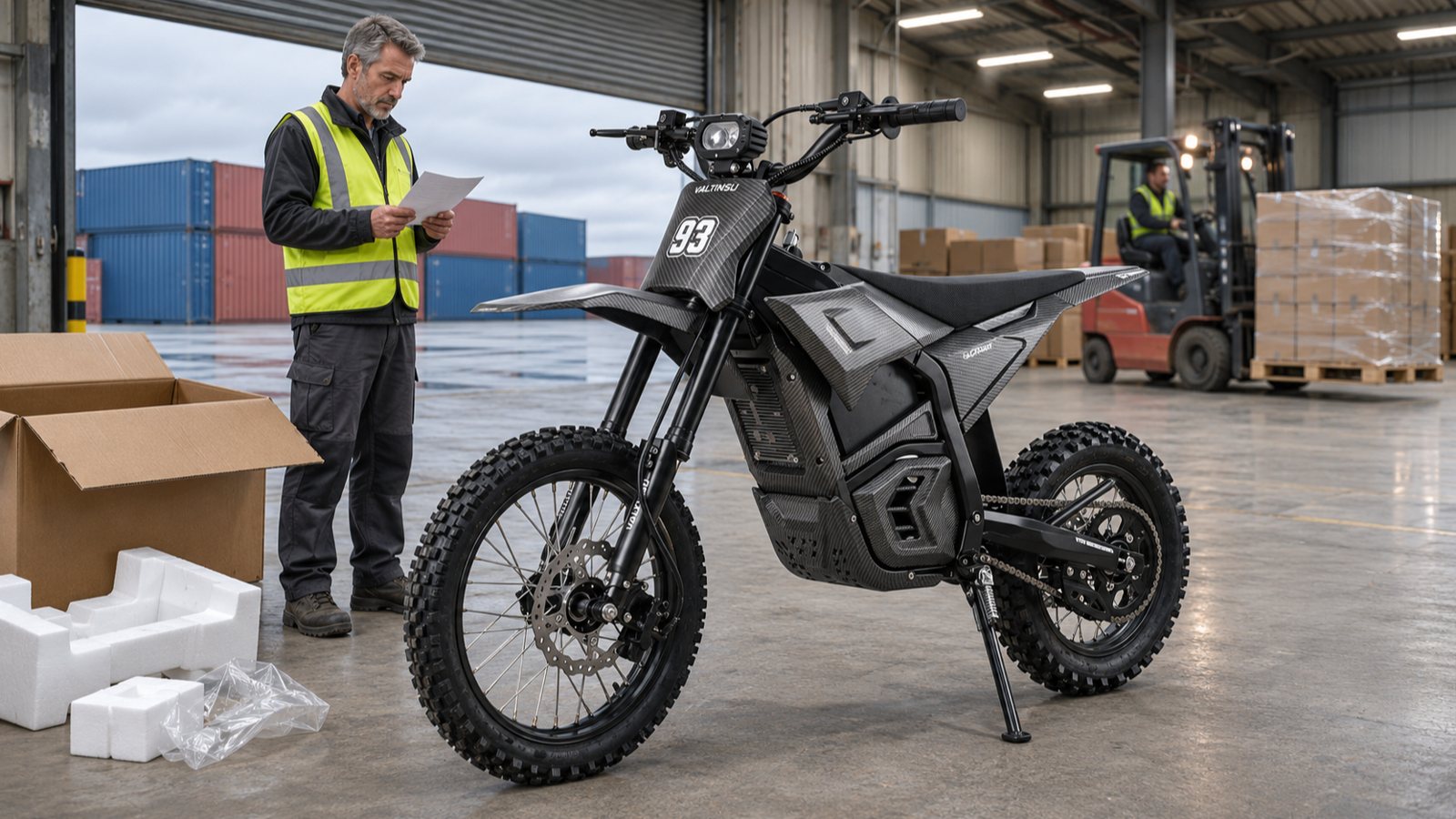
Electric dirt bike shipping needs route-specific battery classification, packaging and documents. For international air freight, lithium-ion-powered bikes use UN 3556 under PI 952. Before booking, confirm the battery’s UN 38.3 test summary, watt-hour rating and required state of charge, and declare spare packs separately under the applicable rules.
This guide is for importers, distributors and dealers bringing electric dirt bikes in by container or air. It covers the shipping class, the documents and who prepares them, spare batteries, the reasons shipments get held and the EU battery rules that apply after arrival. Rules were checked on 11 November 2026 against official sources. They change often, so confirm the current rules with your forwarder and the authorities for each shipment.
How an electric dirt bike is classed for shipping
| Mode | Shipping entry | Status (checked 2026-11-11) |
|---|---|---|
| Sea (international) | UN 3556, Vehicle, lithium ion battery powered, class 9 | Mandatory under IMDG Code Amendment 42-24 from 1 January 2026 [2] |
| Air (international) | UN 3556 under ICAO Technical Instructions and IATA rules, packing instruction 952 [1] | In use under the current ICAO / IATA editions |
| US domestic road and rail | UN 3171, Battery-powered vehicle, under the US Hazardous Materials Regulations | US proposal to adopt UN 3556 published February 2026; not yet a final rule when checked [3] |
| Spare batteries shipped alone | UN 3480, Lithium ion batteries | Separate rules; see below |
Note
UN 3556 replaced the older general entry UN 3171 for lithium ion powered vehicles in international sea and air rules. Your forwarder decides the exact entry and paperwork for each route.
The documents, and who prepares them
| Document | What it is | Who prepares it | Legally required? |
|---|---|---|---|
| UN 38.3 test summary | Summary of the eight UN transport tests for the battery type (altitude, thermal, vibration, shock, short circuit and more) | Battery and bike maker; passed to every later distributor | Yes. Makers and distributors must make it available; a website link or QR code is accepted [1] |
| Safety data sheet (SDS or MSDS) | Chemical and safety information for the battery | Battery or bike maker | No transport rule requires it, but forwarders and carriers usually ask for it [1] |
| Dangerous goods declaration | The shipper’s declaration for the dangerous goods | Shipper or forwarder, from the maker’s data | Yes, as each mode requires |
| Packing and labeling details | Marks, battery Wh and state of charge, as each mode requires | Factory packs; forwarder checks | Yes |
| Commercial invoice and packing list | Values, quantities, carton sizes and weights | Seller | Yes, for customs |
| Product certificates | For example CE, UL or national marks, as your market needs | Maker | Depends on market and product class |
| Battery conformity documents (EU) | EU declaration of conformity and CE marking for the battery | The manufacturer prepares them; the importer checks them [6] | Yes in the EU since 18 August 2024 |
For our bikes: the EM-5 product page lists UN 38.3 and MSDS documentation [8], and our retail product pages list CE, UL and GCC for the EM-5 and EM-5 Pro [9]. Before booking, get the test summary and SDS for the exact battery pack supplied, and check which model and part each conformity document covers.
For a deeper look at packing and marking, the US regulator’s own webinar is worth a watch.
Lithium Battery Guide for Shippers Webinar
PHMSA’s webinar explains how to use its Lithium Battery Guide for Shippers. It is based on US rules published in May 2020 and predates UN 3556, so use it alongside the current requirements. · YouTube
How to check a UN 38.3 test summary against your order
Match the test summary to the finished battery pack before you release the order for shipping. Ask us for a photo of the pack label and the summary for that version. Read the two together. [11] [12]
- Identify the pack. Compare its model, chemistry, watt-hour rating and physical description. Check the pack weight as well. A summary prepared for a finished product can use the bike model number. If the same bike comes with different batteries, ask which entry covers yours. [11] [12]
- Trace the report. Find the maker’s and test lab’s names and contact details. Look for the report number and date. One summary can cover several battery models if it includes the required information for each. [11] [12]
- Check the results. Look for the tests performed, the result of each test, and the edition and amendments of the UN test manual used. Check the reference to assembled battery testing where applicable. Find the name and job title of the person responsible for the summary. [11] [12]
If the file describes only a cell inside the pack, ask us for the entry that identifies the finished pack or the bike containing it. A matching cell brand alone cannot establish which pack the summary covers. [11] [12]
Our battery data for your forwarder
Forwarders need the battery energy in watt-hours. Worked out from our battery specs (volts × amp-hours):
| Model | Battery | Energy (worked out) | Carton size | Units per 40 ft high-cube |
|---|---|---|---|---|
| EM-5 (48V) | 48V 23.4Ah | about 1,120 Wh | 1365 × 310 × 640 mm | 252 |
| EM-5 Pro (60V) | 60V 27Ah | about 1,620 Wh | 55.5 × 13.8 × 25.2 in (about 1410 × 350 × 640 mm) | 197 |
| EM-5 Ultra (72V) | 72V 25Ah, Samsung cells | about 1,800 Wh | Same as EM-5 Pro | 197 |
Note
Container figures are for one-model loads. Battery pack weight is not listed; ask us for the figure for each model.
Shipping by air
Full container orders go by sea. Air is used for samples and urgent orders, and it has stricter rules:
- From 1 January 2026, vehicles with batteries over 100 Wh must ship by air at no more than 30% state of charge, or no more than 25% on the bike’s own battery gauge, unless the states involved approve otherwise [1]. All our EM-5 series packs are well above 100 Wh.
- Lithium ion batteries shipped on their own (UN 3480) go on cargo aircraft only, at no more than 30% state of charge.
- Airlines can add stricter rules of their own. Check with the carrier before you book.
Which air freight entry applies if you remove the battery?
For an air sample with one lithium ion battery, choose the entry by where the bike’s own pack sits when the crate is closed. [12] [13]
| How the sample is packed | How to book it |
|---|---|
| Battery in its holder, front wheel removed | Use UN 3556 and PI 952. The front wheel can come off to fit the crate. Secure the pack in its holder, protect it against damage and short circuits, and prevent the bike from starting accidentally. [13] |
| Battery removed and packed beside the bike in the same outer crate | Use UN 3481 and PI 966 for lithium ion batteries packed with equipment. For a pack over 100 Wh, Section I applies. [12] [13] |
| Battery removed and shipped in a package on its own | Book the battery package as UN 3480 under PI 965. Identify that package on the packing list so the forwarder can match it to the declaration. [12] |
Before choosing the same-crate option, ask us for the pack weight. Under PI 966 Section I, the standard limit per package is 5 kg of batteries on a passenger aircraft or 35 kg on a cargo aircraft. The bike and crate are excluded from that weight. Plan for a state of charge of 30% or less. A higher charge requires approval from the authorities in both the state of origin and the state of the operator, under their written conditions. [12]
Shipping cost, lead time and delivery
We do not publish fixed freight prices or transit times, because they change by route and season. Ask for an itemized quote covering freight, dangerous goods handling, origin and destination charges, customs brokerage, duties and taxes, insurance and final delivery. Give the model, quantity, destination, carton sizes, gross weight, number of spare batteries and the agreed Incoterm.
For timing, ask separately for production lead time, booking time, transit, customs clearance and final delivery, and check how long the quote is valid.
Delivery terms matter too. Ask how bikes are packed (carton, crate or pallet), whether final delivery includes a liftgate or appointment, who pays duties and taxes under the agreed Incoterm, and how to record and claim transport damage. Inspect cartons on arrival and note any damage on the delivery receipt before signing.
How to check wooden crates, pallets and wheel blocks
Check the skid and the wood holding the bike in place, even when the crate walls are plywood. A solid timber base or a loose wooden wheel block can bring regulated wood into the shipment. Ask us for photos of the base, bracing and treatment marks before loading. [14] [15] [16] [17]
| Destination from China | What the importer should check |
|---|---|
| United States | Inspect the pallet and loose timber bracing for the official ISPM 15 mark and signs of pests. The mark includes the IPPC symbol, country code, facility identifier and treatment code. HT means heat treatment. [14] |
| Canada | Get a clear photo of the mark on regulated wood packaging made in China. Canada does not accept a phytosanitary certificate in place of that mark for wood packaging originating in China. [15] |
| European Union | Packaging made entirely of processed wood such as plywood is exempt. Check the runners under the crate. If they are solid timber, the exemption for packaging made entirely of processed wood no longer applies. [16] |
| Mexico | For regulated wood packaging, look for a legible, permanent mark on at least two opposite sides. Ask for photos of both sides before wrapping. Mexico does not allow adhesive labels or stickers for this mark. [17] |
Spare batteries
A spare battery is not part of the vehicle. When a bike ships with a spare pack, the bike goes as UN 3556 and the spare as UN 3480. They cannot be declared together as batteries packed with equipment (UN 3481) [1]. Spare batteries have their own packing, labeling and, by air, state of charge rules. If your customers want spare batteries, plan them as a separate line on the booking.
Why shipments get held
| Problem | What happens | How to avoid it |
|---|---|---|
| No UN 38.3 test summary for the battery type | The carrier may delay or refuse acceptance | Get the summary for each model before booking |
| Battery Wh missing or wrong on paperwork | Booking rejected or corrected at the port | Use the maker’s figure, matched to the label on the pack |
| Classification not confirmed for each transport leg | Shipment held or rebooked; penalties possible | Confirm the classification and documents for each leg; US road and rail shipments of qualifying vehicles have exceptions under 49 CFR 173.220(h)(1) [4] |
| Spare batteries packed in with bikes and not declared | Shipment held | Declare spares as UN 3480 |
| State of charge too high for air | Rejected at the airport | Ask the factory to ship at or below 30% |
| Damaged or swollen battery | Cannot ship under normal rules | Inspect before loading; never ship a damaged pack as normal cargo |
| Certificates do not match the model shipped | Customs or market checks stop the goods | Check the model name on every certificate |
How to handle a damaged battery return in the US or Canada
Pause the return booking if a customer reports a swollen, leaking or crushed pack. Record the pack model, what happened and any visible damage. Ask the maker or a qualified battery specialist to assess its condition before anyone books collection. [13] [18]
- United States. If a damaged pack could short circuit, catch fire or generate dangerous heat, federal rules limit it to road, rail or vessel transport. Each pack needs its own fully enclosing nonmetal inner packaging. The cushioning must be noncombustible, electrically nonconductive and absorbent. Use an authorized outer package that meets Packing Group I requirements and carries the required damaged battery marking. [11]
- Canada. Special Provision 137 bars damaged or defective lithium batteries from air transport. It also forbids transport by any mode if, under normal transport conditions, the pack is likely to break apart rapidly, react dangerously, produce flames or dangerous heat, or release dangerous amounts of toxic, corrosive or flammable gas or vapour. [19]
- Before a Canadian pickup, have the dangerous goods shipper confirm that the pack can travel. For an eligible damaged pack, the shipper must use packing instruction P908 or LP904 as applicable and apply the required damaged battery marking. [19]
After arrival: rules by market
European Union: the Batteries Regulation
The EU Batteries Regulation, (EU) 2023/1542, splits duties by role. The manufacturer prepares the EU declaration of conformity and technical documents; the importer checks them and the CE marking. An importer that markets the battery under its own name or trademark takes on the manufacturer’s duties. Producer registration is a separate role in each country [6]. Confirm each pack’s weight and category before applying the LMT rules below; a light means of transport (LMT) battery is, among other conditions, a sealed battery of 25 kg or less that powers an electric vehicle such as an electric motorcycle [6].
| Requirement | Applies from |
|---|---|
| Conformity assessment, EU declaration of conformity and CE marking for batteries | 18 August 2024 |
| Producer registration in each EU country where you first sell batteries (extended producer responsibility) | 18 August 2025 |
| Battery labels, including capacity on LMT batteries | 18 August 2026, or 18 months after the EU labeling act, whichever is later |
| Battery passport for every LMT battery placed on the market | 18 February 2027 |
| LMT battery and its cells replaceable by an independent professional; spare batteries available for 5 years after the last unit | 18 February 2027 |
Note
Dates from the Regulation as published [6]. Check for later amendments before you rely on a date.
United States
In the US, battery-powered vehicles shipped as cargo are covered by the Hazardous Materials Regulations (49 CFR 173.220) [4], and lithium batteries must be of a type that passed UN 38.3 with a test summary available (49 CFR 173.185) [5]. Vehicles not made mainly for public-road use may enter under Box 8 of Form HS-7, supported by evidence of their off-road design [10] (see our license guide).
Canada
In Canada, dirt bikes made only for off-road use that can exceed 32 km/h generally need restricted-use vehicle compliance [7]. A speed limiter alone does not create an exemption. Settle this with your supplier and a customs broker before the first order.
A first import, step by step
| Step | Who | What |
|---|---|---|
| 1. Confirm models and documents | Importer and factory | UN 38.3 summary, SDS and certificates for each model |
| 2. Choose a forwarder that handles class 9 | Importer | Share battery Wh, carton sizes and units per container |
| 3. Check market rules | Importer and customs broker | Import class, duties, battery producer registration |
| 4. Book and declare | Forwarder | Dangerous goods declaration under the right UN entry |
| 5. Pack and label | Factory | Class 9 marks, battery data, state of charge if by air |
| 6. Arrival and clearance | Customs broker | Invoice, packing list, certificates |
| 7. Store and charge safely | Importer or dealer | Dry, clear area; charge with the supplied charger |
Example scenario
Example (hypothetical): a new distributor in Germany orders one 40 ft high-cube of EM-5 Pro bikes, 197 units. Before booking, they get the UN 38.3 test summary and SDS for the 60V pack and the CE documents, and register as a battery producer in Germany. The forwarder books the container as UN 3556. Two sample bikes sent ahead by air ship at 30% charge. This illustrates document preparation, not a promised clearance; customs may still inspect the shipment or ask for more evidence.
Common mistakes
- Booking a forwarder that does not handle class 9 goods.
- Treating an SDS as enough. The UN 38.3 test summary is the document that is required.
- Adding spare batteries to the container at the last minute without declaring them.
- Forgetting EU producer registration until the goods arrive.
- Shipping samples by air at full charge.
See our certificates and battery documents, or ask our team for a shipping quote.
Rules checked: 11 November 2026.
FAQ
How are electric dirt bikes shipped?
Electric dirt bikes ship as dangerous goods, because of their lithium batteries.
| Route | Entry |
|---|---|
| Sea and air | UN 3556, Vehicle, lithium ion battery powered, class 9 |
| US domestic road and rail | UN 3171, until a proposed rule is final |
The IMDG Code edition that includes UN 3556 became mandatory at sea on 1 January 2026. Your forwarder confirms the entry for each route.
What is UN38.3?
UN 38.3 is a set of UN transport tests that every lithium cell and battery type must pass before it can be shipped.
- Tests: altitude, thermal, vibration, shock, short circuit and more.
- Test summary: makers and later distributors must make one available; a website link or QR code is accepted.
- Before booking: ask for the summary for each model before booking space.
Do I need an MSDS to ship lithium batteries?
No transport rule requires one. IATA's battery guidance says neither its rules nor the rules for other modes require a safety data sheet for batteries. Carriers or forwarders may still ask for one, so get it from your supplier together with the UN 38.3 test summary for the exact battery pack. Our EM-5 product page lists both; ask for the documents themselves before booking.
Can you ship an electric dirt bike by air?
Yes, an electric dirt bike can ship by air, as dangerous goods under packing instruction 952.
- Charge limit: from 1 January 2026, vehicles with batteries over 100 Wh must ship at no more than 30% state of charge, or 25% on the bike's own gauge, unless the states involved approve otherwise.
- Our packs: our EM-5 series packs hold about 1,120 to 1,800 Wh.
- Airlines: airlines may add stricter rules, so check before you book.
How much does it cost to ship electric dirt bikes?
We do not publish fixed freight prices for electric dirt bikes, because they change by route, season and order. Ask for an itemized quote instead.
- Quote lines: freight, dangerous goods handling, origin and destination charges, customs brokerage, duties and taxes, insurance and final delivery.
- What to send: the model, quantity, destination, carton sizes, gross weight, spare batteries and Incoterm.
- Timing: ask separately for production, transit and clearance times.
Can spare batteries ship in the same container as the bikes?
Yes, if they are declared. The bikes ship as UN 3556 and the spare packs as UN 3480, lithium ion batteries. They cannot be declared together as batteries packed with equipment (UN 3481). By air, spare batteries shipped on their own go on cargo aircraft only, at 30% charge or less, so plan them as a separate line.
Who prepares the shipping documents?
The factory, your forwarder and your customs broker each prepare part of the shipping documents.
| Who | Prepares |
|---|---|
| Factory | Battery data, the UN 38.3 test summary, an SDS if asked, product compliance documents, the invoice and the packing list |
| Forwarder | The dangerous goods declaration, where the mode requires it |
| Customs broker | Customs clearance |
Agree who does what before the first booking; paperwork that does not match the pack labels is a common cause of delays.
What do EU importers need to do about batteries?
What EU importers must do about batteries depends on their role under Regulation (EU) 2023/1542.
- Manufacturer: prepares the declaration of conformity and technical documents.
- Importer: checks those documents and the CE marking.
- Own-brand seller: if you market the battery under your own name, you take on manufacturer duties.
- Producer registration: applies country by country.
Confirm each pack's weight and category before applying the LMT label and passport rules.
How many electric dirt bikes fit in a 40-foot high-cube container?
Our published specifications list 252 EM-5 units or 197 EM-5 Pro or EM-5 Ultra units per 40-foot high-cube container in one-model loads, one bike per carton. The EM-5 carton is 1365 × 310 × 640 mm. Before booking:
- Confirm the loading plan for the exact packaging, accessories and model mix.
- Give your forwarder carton sizes, weights and battery watt-hours.
- Book the container once the forwarder has confirmed the plan.
Can I import electric dirt bikes into Canada?
Check first. Transport Canada says dirt bikes made only for off-road use that can exceed 32 km/h generally need restricted-use vehicle compliance to be imported, and a speed limiter alone does not create an exemption. All our EM-5 models are listed well above that speed. Ask for written evidence of the exact model's compliance before the first order.
Does a UN 38.3 test summary expire every year?
No. IATA gives the summary no fixed expiry date. It remains valid while the battery design stays within the tested type. For a repeat order, ask us whether the pack design has changed since the report. A change that could materially affect a test result requires new testing. [12]
Can a dealer carry an EM-5 Pro sample battery in passenger baggage on a US flight?
No. Our EM-5 Pro pack is rated at 60 V and 27 Ah, which works out to 1,620 Wh. The FAA limit for this kind of spare battery in passenger baggage is 160 Wh. Lowering the charge does not change the pack's watt-hour rating. Book the battery as dangerous goods cargo. [12] [20] [21]
Does writing damage on a US truck delivery receipt file a freight claim?
No. For a US motor freight claim covered by 49 CFR 370.3, the receipt note alone does not file the claim. Send a written claim to the proper carrier within the deadline in the bill of lading or carriage contract. [22]
- Identify the shipment, for example by its bill of lading number. [22]
- State that you hold the carrier liable for the damage. [22]
- Request a specific amount or give enough information to calculate it. [22]
References
- Lithium Battery Guidance Document 2026. IATA. https://www.iata.org/contentassets/05e6d8742b0047259bf3a700bc9d42b9/lithium-battery-guidance-document.pdf
- IMDG Code. International Maritime Organization. https://www.imo.org/en/publications/Pages/IMDG%20Code.aspx
- HM-215R: Harmonization with international standards (proposed rule, February 2026). PHMSA, U.S. Department of Transportation. https://public-inspection.federalregister.gov/2026-02575.pdf
- 49 CFR 173.220, Internal combustion engines, vehicles, machinery and battery-powered equipment. eCFR. https://www.ecfr.gov/current/title-49/subtitle-B/chapter-I/subchapter-C/part-173/subpart-E/section-173.220
- 49 CFR 173.185, Lithium cells and batteries. eCFR. https://www.ecfr.gov/current/title-49/subtitle-B/chapter-I/subchapter-C/part-173/subpart-E/section-173.185
- Regulation (EU) 2023/1542 concerning batteries and waste batteries. EUR-Lex. https://eur-lex.europa.eu/eli/reg/2023/1542/oj/eng
- Road vehicles: are they regulated?. Transport Canada. https://tc.canada.ca/en/road-transportation/importing-vehicle/road-vehicles-are-they-regulated
- VALTINSU EM-5 electric dirt bike: product page. VALTINSU (valtinsu.com). https://valtinsu.com/product/cool-stylish-electric-off-road-adult-motorcycle-dirt-bike-em-5/
- VALTINSU EM-5 Off-Road Electric Dirt Bike: specifications. VALTINSU (valtinsusport.com). https://valtinsusport.com/products/electric-off-road-adult-dirt-bike-em-5-with-light
- 49 CFR 591.5, Requirements for entry. eCFR. https://www.ecfr.gov/current/title-49/subtitle-B/chapter-V/part-591/section-591.5
- 49 CFR 173.185, Lithium cells and batteries, paragraphs (a)(3) and (f). US Department of Transportation, Pipeline and Hazardous Materials Safety Administration. https://www.ecfr.gov/current/title-49/subtitle-B/chapter-I/subchapter-C/part-173/subpart-E/section-173.185
- Battery Guidance Document: Transport of Lithium Metal, Lithium Ion and Sodium Ion Batteries, revised for the 2026 regulations. International Air Transport Association. https://www.iata.org/contentassets/05e6d8742b0047259bf3a700bc9d42b9/lithium-battery-guidance-document.pdf
- UN 3556 Vehicle, lithium ion battery powered: ICAO Special Provisions A154 and A214 and Packing Instruction 952. German Federal Institute for Materials Research and Testing, Dangerous Goods Database. https://www.dgg.bam.de/dgginfo/detailinfo/icao/qn6s7qq8?lang=en
- Import ISPM 15-Compliant Wood Packaging Material into the United States. US Department of Agriculture, Animal and Plant Health Inspection Service. https://www.aphis.usda.gov/plant-imports/wood-packaging-material/import
- D-98-08: Entry requirements for wood packaging material into Canada. Canadian Food Inspection Agency. https://inspection.canada.ca/en/plant-health/invasive-pests-and-plants/directives/forest-products/98-08
- Requirements for wood packaging & dunnage. European Commission. https://food.ec.europa.eu/plants/plant-health-and-biosecurity/trade-plants-plant-products-non-eu-countries/requirements-wood-packaging-dunnage_en
- NOM-144-SEMARNAT-2017, medidas fitosanitarias y requisitos de la marca para el embalaje de madera, apartado 4.2.4. Secretaría de Medio Ambiente y Recursos Naturales, Diario Oficial de la Federación, México. https://sidof.segob.gob.mx/notas/docFuente/5514060
- Understanding the Risks of Damaged, Defective, or Recalled (DDR) Lithium Batteries. US Department of Transportation, Pipeline and Hazardous Materials Safety Administration. https://www.phmsa.dot.gov/sites/phmsa.dot.gov/files/2023-03/final.pdf
- Transporting batteries: Transport requirements for damaged or defective lithium metal/ion cells and batteries. Transport Canada. https://tc.canada.ca/en/dangerous-goods/safety-awareness-materials-faq/industry/transporting-batteries
- Airline Passengers and Batteries. US Federal Aviation Administration. https://www.faa.gov/hazmat/packsafe/airline-passengers-and-batteries
- VALTINSU EM-5 PRO Electric Dirt Bike. VALTINSU. https://valtinsu.com/product/electric-off-road-pit-bike-dirt-bike-em-5-pro/
- 49 CFR 370.3, Filing of claims. US Department of Transportation, Federal Motor Carrier Safety Administration. https://www.ecfr.gov/current/title-49/subtitle-B/chapter-III/subchapter-B/part-370/section-370.3
About this guide
Every number here comes from our own spec sheets. We do not report ride tests we have not run. Rated figures are marked.
Update history