

ELECTRIC DIRT BIKE
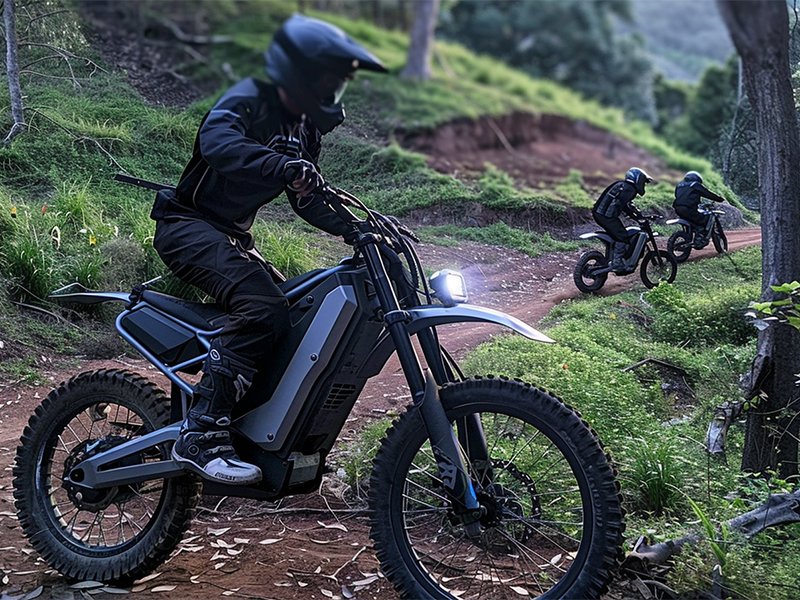
VALTINSU EM-5
EXPLORE MORE
ELECTRIC DIRT BIKE
VALTINSU EM-5 PRO
EXPLORE MORE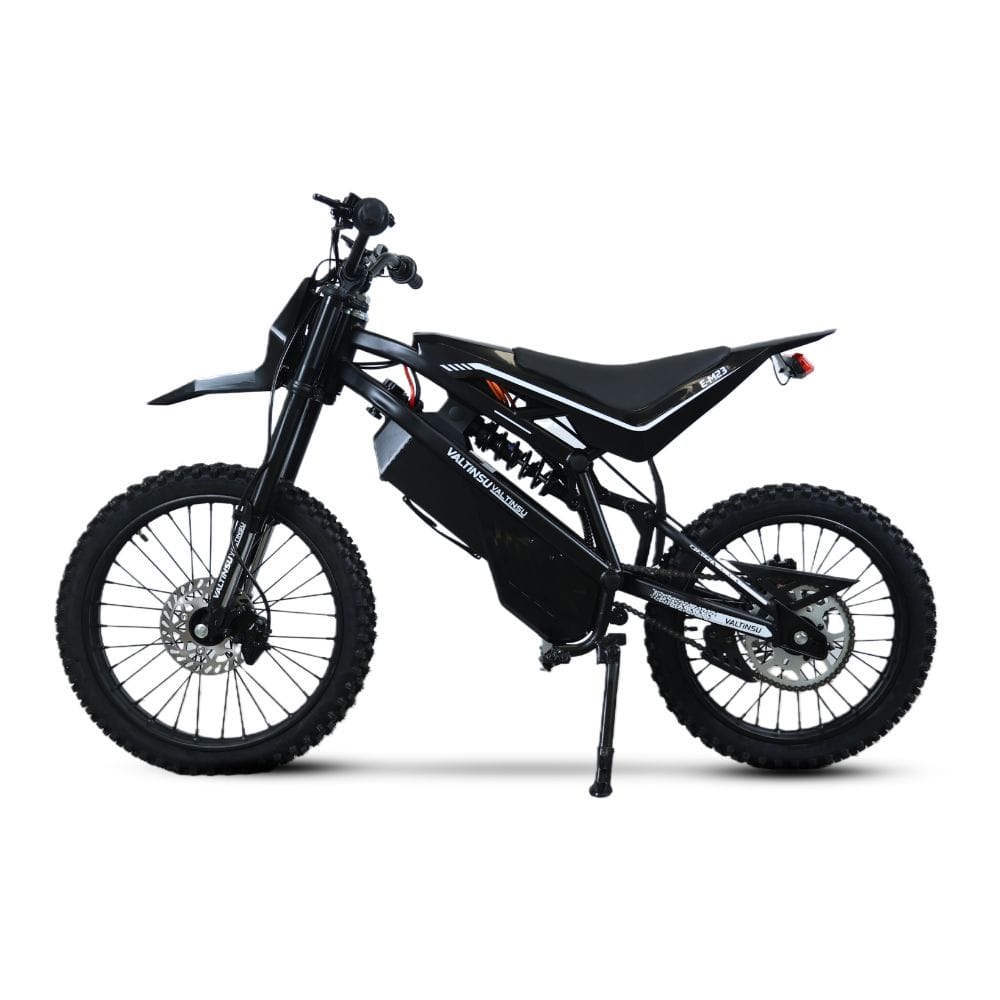
ELECTRIC DIRT BIKE
In general, a 48V 1500W setup can reach around 28–36 MPH under suitable riding conditions. Some models may be slower, while optimized setups with the right battery, controller, gearing, and tires can reach higher speeds.
The important thing is that 48V and 1500W do not determine top speed by themselves. The complete electrical and mechanical system matters.
For buyers comparing electric dirt bikes, especially distributors and dealers, understanding this difference is more useful than looking at the motor wattage alone.
A typical 48V 1500W electric bike can reach approximately 28–35 MPH on relatively flat ground.
For an electric dirt bike, the actual number can vary quite a bit. A lightweight bike with a fully charged battery and an unrestricted controller may reach the upper end of the range. A heavier bike with smaller battery output, lower gearing, or an electronically limited controller may stay closer to 25–30 MPH.
For reference, some current 48V 1500W electric models list maximum speeds around 31–36 MPH, while other 1500W setups are rated closer to 30–32 MPH.
So, rather than saying every 48V 1500W bike will run at exactly 35 MPH, it is more realistic to use 28–36 MPH as a general performance range.
For readers who use kilometers per hour, the approximate conversion is:
Speed | MPH | KM/H |
Lower range | 28 MPH | 45 km/h |
Typical range | 30 MPH | 48 km/h |
Typical upper range | 35 MPH | 56 km/h |
Higher performance | 36 MPH | 58 km/h |
So when a manufacturer advertises a 48V 1500W electric dirt bike at 50–55 km/h, that is roughly 31–34 MPH.
Some 1500W electric dirt bike products currently list speeds around 32 MPH, while others advertise up to 36 MPH.
Not necessarily.
This is one of the most common misunderstandings when comparing electric bikes.
1500W describes the motor’s power rating. It does not directly equal a specific top speed.
Two electric dirt bikes can both use a 48V 1500W motor but have different top speeds because their batteries, controllers, wheel sizes, gearing, vehicle weight, and riding modes are different.
For example, a 48V 1500W hub motor tested with a 26-inch wheel can be advertised around 33 MPH, while another setup using a different controller or wheel configuration may reach a different speed.
That is why the motor specification should always be evaluated together with the rest of the power system.
Several factors can change the actual MPH you see on the display.
A 48V battery supplies the electrical system with its operating voltage, while battery capacity affects how long the bike can maintain performance.
A battery with a higher Ah rating does not automatically make the bike faster. However, a battery that can deliver enough current to the controller and motor can help the system maintain power under load.
Battery voltage can also drop during hard acceleration or when the battery is getting low. This is commonly known as voltage sag and can reduce performance.
Hub motors and mid-drive motors deliver power differently.
A hub motor is relatively simple and common on electric bikes. A mid-drive system can take advantage of the bike’s gearing and may offer different acceleration and hill-climbing characteristics.
For an electric dirt bike, motor tuning is particularly important because riders often care about low-speed torque and acceleration, not just maximum MPH.
The controller determines how much electrical power is delivered to the motor.
A 1500W motor paired with a controller that limits current will not necessarily produce the same performance as a system designed to provide the motor with more current.
The controller can also be programmed with different riding modes or speed limits.
This is one reason two bikes with the same 48V 1500W rating can feel completely different on the trail.
Weight has a noticeable effect on acceleration and top speed.
A lighter rider on a lightweight bike will generally reach the motor’s maximum speed more easily than a heavier rider carrying additional equipment.
The difference becomes even more obvious when riding uphill or on loose terrain.
A smooth paved surface creates much less rolling resistance than sand, mud, gravel, or loose dirt.
Electric dirt bikes are designed around off-road performance, so maximum speed on a trail should not be compared directly with a speed test performed on flat pavement.
Tire size, tread pattern, tire pressure, suspension setup, and surface conditions all influence how efficiently the bike converts motor power into forward movement.
Gearing is another important part of the speed equation.
A setup designed for stronger low-speed acceleration and climbing may sacrifice some top-end speed. A setup designed for higher wheel speed may give up some low-speed torque.
Wheel diameter also changes the relationship between motor RPM and ground speed.
For this reason, there is no single MPH number that applies to every 48V 1500W configuration.
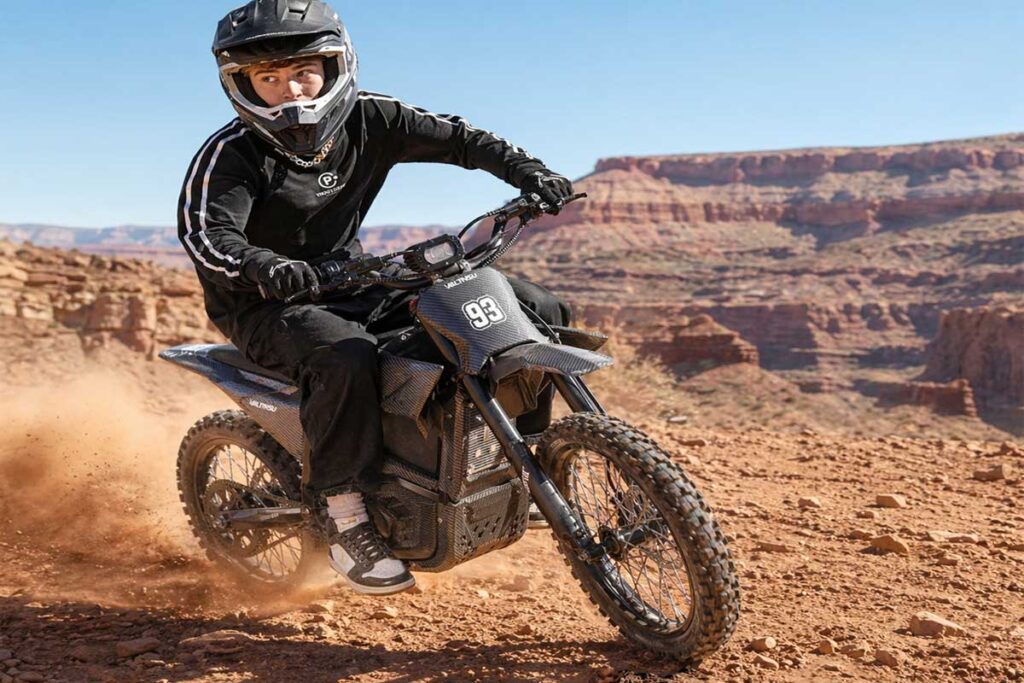
For recreational off-road riding, yes, 1500W is a fairly strong power level.
A 48V 1500W system can provide noticeably stronger acceleration than lower-power electric bikes, while still being easier to manage than some high-power electric motorcycles.
The main advantage is not simply the top speed.
A well-designed 1500W electric dirt bike can provide useful power for:
Trail riding
Private-property riding
Dirt paths
Light hills
Recreational off-road riding
Beginner-to-intermediate electric dirt bike applications
For a manufacturer or distributor, this makes the 48V 1500W category interesting because it sits between entry-level electric bikes and much higher-power electric motorcycles.
In general, a 1500W system has more power available than a 1000W system.
That does not mean the 1500W bike will always have a dramatically higher top speed.
The difference may be more noticeable in acceleration, hill climbing, and maintaining speed under load.
For example, a 1000W electric bike may perform well on flat ground but lose speed more quickly when climbing. A properly matched 1500W system can provide additional power to maintain speed in those conditions.
For off-road riding, that extra power can sometimes matter more than the difference in advertised top speed.
For dealers comparing electric dirt bike suppliers, it is worth looking beyond the headline specification.
A supplier may advertise a bike as “48V 1500W,” but the actual riding experience depends on the complete configuration.
Before placing a wholesale order, ask about:
Continuous vs. peak motor power
Battery capacity and discharge capability
Controller current rating
Maximum speed
Speed-limiting options
Brake specifications
Suspension components
Tire size and type
Maximum rider weight
Spare parts availability
OEM and ODM options
At VALTINSU, we focus on electric off-road models where the motor, battery, controller, chassis, suspension, and braking system are considered as one complete package.
For B2B customers, this approach is particularly important because a good electric dirt bike needs to perform consistently across different markets rather than simply having an impressive number on a product page.
For many recreational applications, 48V 1500W is a practical middle-ground configuration.
It offers considerably more performance than typical low-power commuter e-bikes without moving immediately into the extreme power levels used by high-performance electric motorcycles.
If your priority is trail acceleration, hill climbing, and recreational off-road performance, 1500W can be a good starting point.
However, if your priority is maximum speed, you should compare the complete powertrain, rather than choosing a bike based only on its wattage.
So, how fast is 48V 1500W in MPH?
For most setups, a reasonable expectation is around 28–36 MPH, with approximately 30–35 MPH being a useful real-world target for a well-matched system.
But speed is only one part of the equation.
For an electric dirt bike, motor torque, controller tuning, battery performance, suspension, tires, brakes, and overall vehicle weight can have just as much impact on the riding experience.
If you are sourcing electric dirt bikes for a dealership or distribution business, it is better to evaluate the complete specification instead of choosing a supplier based on the highest advertised MPH.