
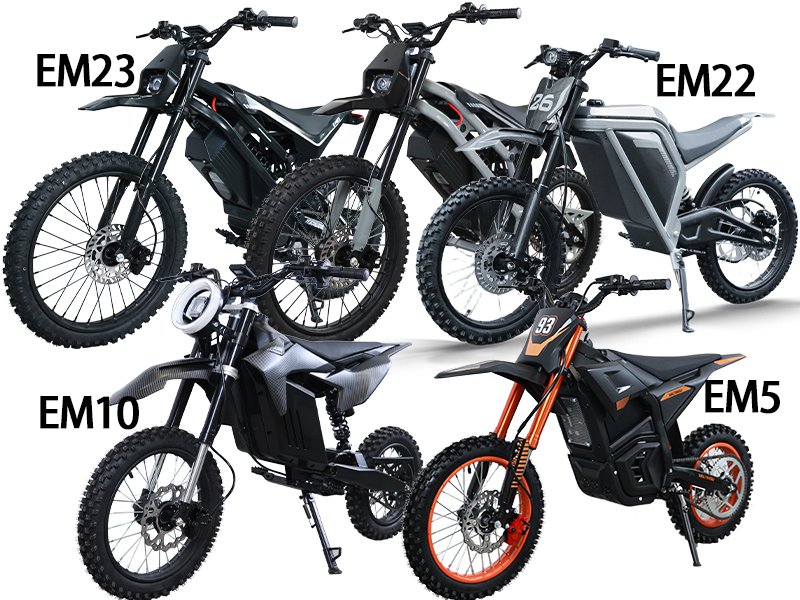

VÉLO ÉLECTRIQUE TOUT-TERRAIN
VALTINSU EM-5
EN SAVOIR PLUS
VÉLO ÉLECTRIQUE TOUT-TERRAIN
VALTINSU EM-5 PRO
EN SAVOIR PLUS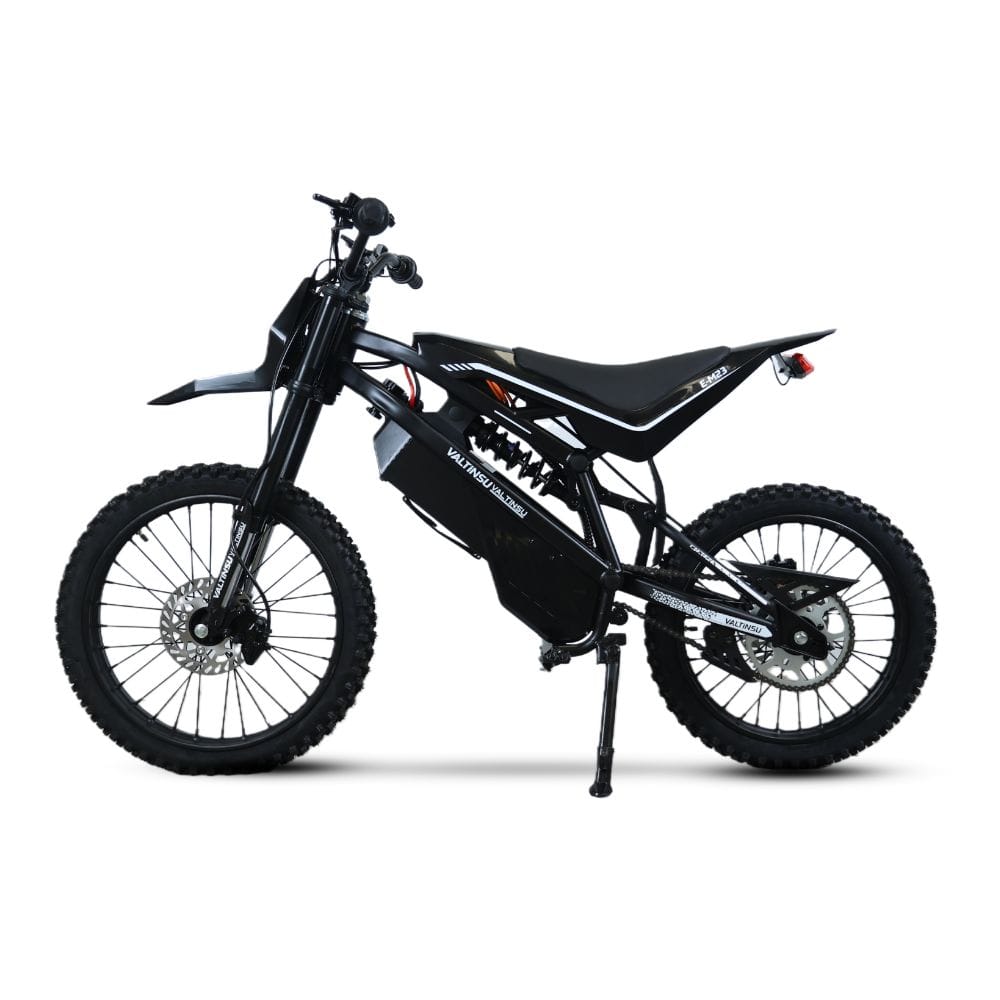
MOTO-CROSS ÉLECTRIQUE
Recreational 125cc four-stroke models commonly reach around 40–55 mph (64–89 km/h), while some race-oriented 125cc two-stroke models may reach approximately 60–70 mph (97–113 km/h) under suitable conditions.
However, engine displacement alone does not determine top speed. If you are comparing motos hors route 125cc for personal use or wholesale purchasing, you should also evaluate engine type, power delivery, gearing, rider load, and the conditions under which the speed was measured.
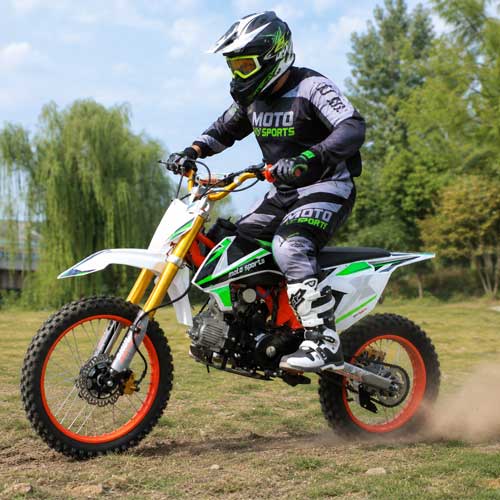
The top speed of a 125cc dirt bike varies considerably between models.
For general reference, the following ranges can help explain the differences:
| 125cc Dirt Bike Type | Vitesse de pointe approximative |
|---|---|
| Recreational 125cc 4-stroke | 40 à 55 mph (64 à 89 km/h) |
| Race-oriented 125cc 2-stroke | 60 à 70 mph (97 à 113 km/h) |
| Other 125cc configurations | Varies by model and setup |
These figures are general reference ranges, not guaranteed specifications. Actual performance depends on the motorcycle’s engine design, transmission, gearing, tires, rider weight, and riding environment.
A manufacturer’s published top-speed figure should always be checked against the exact model and its test conditions.
Engine displacement describes the approximate volume displaced by the engine’s piston or pistons. It does not directly describe maximum horsepower, torque, or vehicle speed.
Two motorcycles can both have 125cc engines but use different:
Engine configurations
Intake and exhaust designs
Systèmes de transmission
Final drive ratios
Poids des véhicules
Caractéristiques de distribution d'énergie
For this reason, a competition-oriented 125cc two-stroke and a recreational 125cc four-stroke should not automatically be expected to perform the same way.
Engine type is one of the most important factors when comparing 125cc dirt bikes.
Two-stroke and four-stroke engines use different combustion and power-delivery designs. This can create noticeable differences in acceleration, engine response, and maximum speed.
| Comparaison | 125cc 2 temps | 125cc 4 temps |
|---|---|---|
| Engine cycle | Power stroke every crankshaft revolution | Power stroke every two crankshaft revolutions |
| Livraison de puissance | Often more aggressive, depending on engine design | Often more progressive, depending on engine design |
| Application typique | Competition and performance-oriented riding | Recreational riding and some competition applications |
| General speed reference | Some models may reach 60–70 mph | Many recreational models are around 40–55 mph |
| Entretien | Requires engine-specific two-stroke servicing | Requires four-stroke-specific servicing |
These are general characteristics, not rules that apply to every motorcycle.
A competition-oriented 125cc two-stroke dirt bike can offer a high power-to-weight ratio and responsive acceleration.
Some models may reach approximately 60–70 mph (97–113 km/h) on suitable flat ground.
However, actual performance depends on the engine’s condition, tuning, transmission ratios, final gearing, and rider setup.
A competition motorcycle should also be evaluated based on its intended riding environment. Its maximum speed does not necessarily make it the most suitable choice for a beginner or recreational rider.
Recreational 125cc four-stroke dirt bikes commonly reach approximately 40–55 mph (64–89 km/h).
Many are designed around manageable power delivery and general recreational use rather than maximum speed.
For buyers comparing these motorcycles, it is important to consider more than the top-speed figure. Throttle response, low-speed control, starting characteristics, and the intended rider experience can be equally important.
The right engine depends on the intended application.
For competition-oriented performance, evaluate the specific two-stroke model and its power characteristics.
For recreational use, compare the four-stroke model’s power delivery and overall configuration.
For wholesale purchasing, request separate specifications for each engine version instead of treating all 125cc motorcycles as one product category.
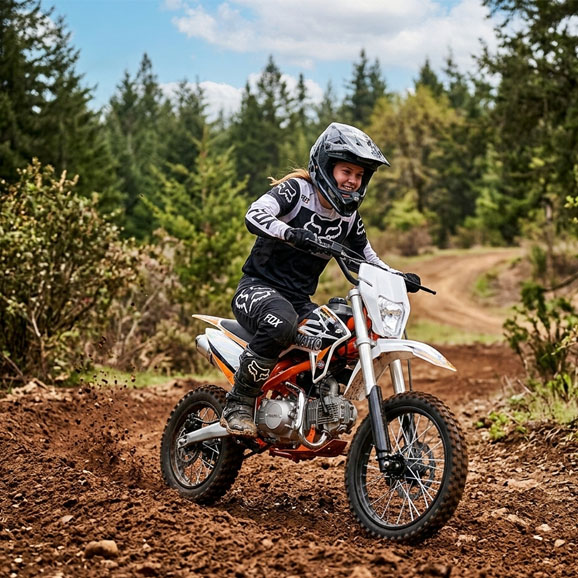
A published top-speed figure does not tell the whole story. Several factors influence how fast a dirt bike can actually travel.
Engine displacement is only one part of motorcycle performance.
Two 125cc engines may have different power outputs because of their design, tuning, and intended application.
When comparing models, ask for:
Engine type: 2-stroke or 4-stroke
Rated power, where available
Configuration du moteur
Spécifications de transmission
Manufacturer’s recommended operating conditions
Avoid comparing two motorcycles based on engine displacement alone.
Gearing affects the relationship between engine speed and wheel speed.
Taller gearing can increase potential top speed if the engine has enough power to pull the higher gearing. However, it may reduce acceleration and make climbing more difficult.
Lower gearing generally favors acceleration and low-speed control, but it can reduce potential maximum speed.
For example, two motorcycles with the same engine may have different top speeds because they use different front and rear sprocket combinations.
When evaluating a supplier’s speed claim, ask whether the motorcycle uses its standard factory gearing or a modified setup.
Rider weight affects how quickly a motorcycle accelerates and combien power is required to maintain speed.
A heavier rider may take longer to reach the motorcycle’s maximum speed, especially on a model with limited power.
A short test run may therefore show a lower speed than the motorcycle could potentially achieve under different conditions.
For a fair comparison, rider weight should be recorded alongside the test result.
A dirt bike does not perform identically on every surface.
| Conditions de conduite | Possible Effect on Speed |
|---|---|
| Terrain plat et ferme | More suitable for measuring maximum speed |
| Boue | Greater rolling resistance and reduced traction |
| Sable profond | More resistance and greater power demand |
| Steep uphill terrain | Speed may decrease under load |
| Rough or rocky trails | Safe speed is limited by obstacles and handling |
A top-speed test on flat ground should not be treated as a realistic cruising-speed recommendation for off-road trails.
Tire condition, tire pressure, drivetrain condition, and general maintenance can also affect performance.
A poorly maintained chain, incorrect tire pressure, or mechanical problems may reduce efficiency.
Before testing top speed, make sure the motorcycle is maintained according to its manufacturer’s instructions.
A 125cc dirt bike may be suitable for some adults and beginners, but suitability cannot be determined by engine displacement alone.
The rider’s experience, height, weight, physical ability, and intended terrain should all be considered.
A beginner should prioritize controllable power delivery, predictable handling, suitable seat height, and the ability to manage the motorcycle safely.
A motorcycle with a higher published top speed is not automatically a better beginner motorcycle.
Adults should consider the motorcycle’s frame size, suspension setup, weight capacity, and intended rider category.
A 125cc motorcycle designed for younger riders may have a different chassis and ergonomic configuration from a full-size competition motorcycle.
Do not assume that every 125cc dirt bike is suitable for every adult rider.
For recreational riding, maximum speed is only one consideration.
Riders should also evaluate:
Comfort and riding position
Contrôle à basse vitesse
Performances de freinage
Caractéristiques de la suspension
Exigences de maintenance
Intended terrain
Always follow the manufacturer’s rider and load recommendations.
If you are purchasing a motorcycle from a manufacturer or supplier, a top-speed claim should be supported by more than a number in a product listing.
The following questions can help buyers evaluate the motorcycle more accurately.
Demandez au fournisseur :
Is the engine two-stroke or four-stroke?
What is the exact engine displacement?
What is the rated power, if specified?
What transmission system does the motorcycle use?
Is the engine designed for recreational riding or competition use?
Do not assume that two models with the same displacement have identical performance.
Demandez:
Is the stated speed measured or estimated?
What is the exact motorcycle model and configuration?
Was the test conducted on flat, firm ground?
What was the rider’s approximate weight?
Was the motorcycle using standard factory gearing?
Was the speed measured using GPS or the dashboard display?
Was the result repeated under comparable conditions?
These questions help establish whether two advertised figures can be compared fairly.
A buyer should also confirm:
Front and rear sprocket specifications
Tire sizes
Poids de la moto
Hauteur de selle
Braking configuration
Configuration de la suspension
Recommended rider load
Exigences de maintenance
The final product specification sheet should identify the exact model and configuration being purchased.
Not every buyer evaluates a 125cc dirt bike in the same way.
| Type de consommateur | Priorité principale | Évaluation recommandée |
|---|---|---|
| Individual beginner | Manageable performance | Power delivery, seat height, handling, and rider suitability |
| Experienced recreational rider | Overall riding experience | Engine response, gearing, suspension, and terrain suitability |
| concessionnaire de motos | Positionnement de produit | Engine type, target customer, specifications, and after-sales requirements |
| Importateur ou grossiste | Spécifications du produit cohérentes | Model configuration, documentation, test evidence, and supply terms |
| Fleet or rental operator | Fiabilité et facilité d'entretien | Maintenance schedule, spare parts, operating requirements, and durability evidence |
For dealers and importers, the key question is not simply which motorcycle has the highest advertised speed.
It is whether the product’s actual configuration and performance characteristics match the expectations of the intended customer group.
A supplier’s top-speed statement should be treated as a claim that needs supporting evidence.
The following process can help buyers evaluate it.
Ask for the full model name, engine type, and configuration.
A general statement such as “125cc dirt bike” is not enough to identify a specific motorcycle.
The specification sheet should identify relevant information, including:
Cylindrée du moteur
Type de moteur
Rated power, if available
Transmission
Sprocket configuration
La taille des pneus
Poids du véhicule
Charge recommandée
Check whether the document refers to the exact model being quoted.
If the supplier advertises a maximum speed, ask for the test conditions and supporting records.
Les informations utiles comprennent :
Date du test
Exact motorcycle configuration
Rider weight or test load
Surface d'essai
Weather and wind conditions, if recorded
Instrument de mesure
Recorded speed results
A video can provide useful context, but a video alone may not establish a reliable or repeatable maximum-speed result.
Only compare speed figures when the important conditions are reasonably similar.
For example, comparing a competition-oriented two-stroke tested on flat ground with a recreational four-stroke tested on a rough trail does not provide a fair performance comparison.
Make sure the motorcycle supplied in the production order matches the configuration used to support the advertised specification.
Changes to gearing, engine tuning, tires, or other components may affect performance.
A useful way to evaluate suppliers is to turn broad marketing statements into specific questions.
| Déclaration marketing | Questions que les acheteurs devraient poser |
|---|---|
| “This 125cc dirt bike reaches 70 mph.” | Which exact model? Is it two-stroke or four-stroke? How was the speed measured? |
| “High-performance 125cc engine.” | What is the rated power? Is a technical specification available? |
| “Fast acceleration.” | Is there a measured acceleration result? What were the test conditions? |
| “Suitable for adults.” | What are the seat height, vehicle weight, recommended load, and intended rider category? |
| “Competition performance.” | What competition application is the motorcycle designed for? Is there supporting technical documentation? |
| “Reliable engine.” | What maintenance schedule, warranty terms, and spare-parts support are available? |
| “Same performance as other 125cc models.” | Are the engine type, gearing, weight, and test conditions comparable? |
A supplier that can clearly explain the product configuration and provide relevant documentation makes it easier for buyers to evaluate the product objectively.
There are several common risks in evaluating top-speed claims.
A two-stroke competition model and a recreational four-stroke model may have very different performance characteristics.
Always compare the same engine category where possible.
A specification sheet may show a stated top speed without explaining how the figure was obtained.
Ask whether the number is a measured result, manufacturer estimate, or general reference.
A motorcycle with modified sprockets may achieve a different top speed from the standard production configuration.
Confirm whether the quoted result applies to the original setup.
A maximum-speed figure is not a recommendation for riding at that speed on trails.
Terrain, obstacles, visibility, rider experience, and stopping distance all affect safe riding speed.
Engine displacement does not define the motorcycle’s complete size, ergonomics, or intended rider category.
Dealers should confirm the intended customer group before selecting inventory.
Imagine an importer receives quotations from two suppliers.
Both suppliers advertise a 125cc dirt bike.
| Produit | Fournisseur A | Fournisseur B |
|---|---|---|
| Cylindrée du moteur | 125cc | 125cc |
| Type de moteur | 2-course | 4-course |
| Advertised top speed | 68 mph | 50 mph |
| Gearing information | Non fourni | Standard gearing stated |
| Conditions d'essai | Non fourni | Non fourni |
| Supporting test record | Non fourni | Non fourni |
At first glance, Supplier A appears to offer a faster motorcycle.
However, the importer does not yet have enough information to make a reliable purchasing decision.
The buyer should ask both suppliers for:
Exact engine specifications.
Rated power, if available.
Standard front and rear sprocket sizes.
Vehicle weight and recommended load.
Top-speed measurement method.
Test conditions and supporting records.
Confirmation that the quoted configuration matches the production model.
The importer may then discover that the two motorcycles serve different customer groups.
Supplier A may be offering a competition-oriented motorcycle, while Supplier B may be offering a recreational model.
The correct purchasing decision depends on the target market, customer expectations, price positioning, maintenance requirements, and product documentation—not just the highest advertised speed.
The purchasing process does not end when the shipment arrives.
Importers and dealers should establish an incoming inspection process to confirm that the delivered products match the agreed specifications.
| Zone d'inspection | Que vérifier | Preuves à conserver |
|---|---|---|
| Identification du modèle | Confirmer le modèle et la configuration | Purchase order and product labels |
| Moteur | Confirm engine type and identification details | Engine documentation |
| Déplacement | Check against agreed specifications | Fiche technique |
| Transmission | Confirm the specified transmission configuration | Documentation produit |
| Pignons | Check front and rear sprocket sizes | Rapport d'inspection |
| Pneus | Confirm tire sizes and visible condition | Photos d'inspection |
| Freins | Check visible condition and operation | Liste de contrôle d'inspection |
| Attaches | Check assembly and specified tightening requirements | Rapport d'inspection |
| Accessoires | Confirm included parts and tools | Liste de colisage |
| Documentation | Check manuals and agreed documents | Liste de contrôle des documents |
Any operational test should follow the manufacturer’s instructions and be conducted in a suitable controlled area by qualified personnel.
If the motorcycle’s performance differs significantly from the agreed specification, record the issue and contact the supplier before retail delivery.
A high top-speed figure does not necessarily mean the motorcycle is suitable for the intended rider.
Evaluate power delivery, handling, size, and maintenance requirements as well.
Two-stroke and four-stroke engines can have different performance characteristics.
Always identify the exact engine type.
Different sprocket combinations can affect acceleration and maximum speed.
Ask for the standard gearing configuration before comparing products.
A supplier’s advertised number should be supported by a clear explanation of the model and test conditions.
Do not treat an unverified marketing statement as a confirmed technical specification.
For dealers and importers, maintenance information, spare-parts availability, warranty terms, and technical support can affect the long-term suitability of a product.
Evaluate these factors before placing a wholesale order.
A 125cc dirt bike typically reaches approximately 40–70 mph. The actual speed depends on engine type, gearing, model design, rider load, and terrain.
A general reference range is approximately 64–113 km/h. Recreational four-stroke models are often around 64–89 km/h, while some performance-oriented two-stroke models may reach approximately 97–113 km/h.
Some competition-oriented 125cc two-stroke models can reach higher speeds than many recreational four-stroke models. However, the exact result depends on the motorcycle’s design and configuration.
Some 125cc two-stroke competition models may reach approximately 70 mph under suitable conditions. This should not be assumed for every 125cc dirt bike, especially recreational four-stroke models.
Some 125cc dirt bikes are suitable for adults, but suitability depends on frame size, seat height, rider weight, experience, and intended use. Engine displacement alone is not enough to determine rider suitability.
Yes. A heavier rider generally increases the load on the motorcycle and may reduce acceleration or achievable speed under certain conditions. The effect depends on engine output, gearing, terrain, and other factors.
Changing the sprocket ratio can alter the relationship between acceleration and potential top speed. Taller gearing may increase potential maximum speed if the engine can pull it, but it can reduce acceleration and climbing performance.